


































.png?width=444&height=266&name=Student-support%20(1).png)




.png?width=318&height=279&name=Evanston(tile).png)



.png?width=318&height=279&name=Teams%20Edweb%20(6).png)

.png?width=318&height=279&name=Best_Small_Workplaces-2026(no-text).png)




.png?width=1436&height=956&name=Reading%20Interventions%20(Preview).png)
Looking for opportunities to strengthen reading support across your classrooms? With so many intervention options available, the real question becomes: where do you start to get the most traction?
Here are six free, research-backed interventions aligned to the five pillars of reading: phonological awareness, phonics, fluency, vocabulary, and comprehension. Each includes the research behind it, simple steps to get started, and ready-to-use resources. These are practical, “use it on Monday” strategies designed to help you take immediate action.

Repeated Reading | Fluency, Comprehension | Tiers 1, 2
What it is: Students read the same passage multiple times aloud, either with a partner or a teacher, to build reading rate, accuracy, and expression.
The research: The National Reading Panel (2000) identified repeated oral reading as one of the most effective practices for building fluency, with consistent gains across grades K–12. Repeated reading, especially with feedback and guidance from teachers, peers, or family members, consistently improves word recognition, fluency, and comprehension.
How to use it:
-
Select a passage at the student's instructional level (90–95% accuracy).
-
Pair students; one reads aloud for 1 minute while the partner follows along and provides feedback.
-
Repeat 3–4 times across the week; track words-per-minute to show progress.
Free resource(s):
Elkonin Boxes | Phonics, Phonological Awareness | Tiers 2, 3
What it is: Students use a drawn grid of boxes (one per phoneme) and push a token (or write a letter) into each box as they say each sound in a word, building phonemic awareness and spelling simultaneously.
The research: What Works Clearinghouse reviews of programs using phoneme segmentation tools (including Elkonin boxes) show moderate-to-strong evidence for improving both phonemic awareness and early decoding in K–2 students.
How to use it:
-
Pronounce a target word slowly, stretching it out by sound.
-
Ask the student to repeat the word.
-
Draw "boxes" or squares on a piece of paper, chalkboard, or dry-erase board with one box for each syllable or phoneme.
-
Have the child count the number of phonemes in the word, not necessarily the number of letters. For example, the word 'wish' has three phonemes and will use three boxes: /w/, /i/, /sh/
-
Direct the student to slide one colored circle, cube, or corresponding letter into each cell of the Elkonin box drawing as they repeat the word.
Free resource(s):
Reciprocal Teaching | Comprehension | Tiers 1, 2, 3
What it is: A structured discussion strategy where students take turns leading a group through four comprehension moves - predicting, questioning, clarifying, and summarizing - as they read.
The research: A 2009 study found that elementary students who practiced reciprocal teaching in small peer groups — using strategies like summarizing, questioning, and predicting — outperformed both teacher-led groups and students who received no strategy instruction at all. (Spörer et al., 2009)
How to use it:
-
Before starting, the teacher breaks the reading into smaller sections. Then:
-
Form groups of four and give each student a role card: Summarizer, Questioner, Clarifier, or Predictor.
-
Read a section of the text together.
-
Each student takes their turn in this order:
-
Summarizer shares the key ideas from what was just read.
-
Questioner asks the group questions about anything unclear or interesting.
-
Clarifier tackles the confusing parts and answers the Questioner's questions.
-
Predictor guesses what might come next in the text.
-
-
Rotate roles (everyone shifts one spot to the right) and read the next section.
-
Repeat until the whole text is finished.
Free resource(s):
-
Reciprocal Teaching Handout (younger students)
-
Reciprocal Teaching Worksheet (older students)
Florida Center for Reading Research | Fluency, Phonics, Phonemic Awareness, Vocabulary, Comprehension | Tiers 1, 2, 3
What it is: The Florida Center for Reading Research provides a free database of non-digital learning support activities and tools to support reading instruction for PreK-5th grade students. The activities help students to practice, demonstrate, and extend their learning of what has already been taught, sometimes with teacher assistance and sometimes independently.
The research: The FCRR research center utilizes a robust database of education studies to guide the creation of instructional materials. These materials are based on best practices.
How to use it:
-
Educators can access the resources on the FCRR website and sort activities by grade level and skill area.
-
Educators can download and/or print the PDF worksheets and access instructional materials.
Free resource:
Graphic Organizers | Comprehension, Vocabulary | Tiers 1, 2, 3
What it is: Graphic organizers come in many shapes and forms (Venn diagrams, T-charts, bubble maps, etc.) and can be used for a variety of purposes. In the context of literacy, they can be used to help students organize their ideas, scaffold their thinking, put the text in a visual layout, and compare and contrast two texts, characters, concepts, etc.
The research: Research shows that graphic organizers can improve reading comprehension, particularly for students with learning disabilities (Kim et al., 2004; Manoli & Papadopoulou, 2012).
How to use it:
(This is just one example of how they could be used. There are many others.)
-
Select a piece of narrative text that students have already read.
-
Give each student a blank sheet of paper or a pre-made chart, depending on how much scaffolding students need.
-
Ask students to identify the main theme and write it in the center of the page.
-
Have them draw lines branching out from the main idea, connecting to supporting details they write at the end of each branch.
-
Use the completed maps to drive a small-group or whole-class discussion.
Free resource(s):
Think-Alouds | Comprehension | Tiers 1, 2
What it is: A modeling strategy where the teacher reads aloud and verbalizes their internal thinking process - such as making inferences, noticing confusion, connecting to prior knowledge - to make invisible comprehension strategies visible to students.
The research: The National Reading Panel (2000) identified comprehension strategy instruction, including explicit modeling via think-alouds, as strongly evidence-based for improving reading comprehension across grade levels.
How to use it:
-
Pre-select 2–3 spots in a text where you will stop and think aloud. Try to choose places where the text is complex or a strategy would be especially useful.
-
Use consistent sentence starters: "I'm thinking…", "This reminds me of…", "I'm confused here because…" so students learn the language of metacognition.
-
Gradually release by asking students to think aloud with a partner during subsequent reading.
Free resource:
The Right Intervention Starts with the Right Insight
Of course, not every strategy will work for every student. Effective intervention starts with knowing exactly where the breakdown is happening. Is it at the word level (decoding)? Are they accurate but slow readers (fluency)? Or are they reading the words but losing the meaning (comprehension)? Running records, universal screeners, diagnostic assessments, and progress monitors can help you identify the right intervention and track whether it’s working.
Building Your MTSS Literacy Plan
Want to see how this looks in practice? In our webinar, Building Your MTSS Literacy Plan, we walk through how to use data to pinpoint where students are struggling and align the right supports across tiers.
Watch this short clip to see how districts are connecting screening, progress monitoring, and instruction to build a stronger literacy system.
.png?width=2240&height=1260&name=Build%20Your%20Literacy%20Team%20(thumbnail).png)
Ready to go deeper? Download our free guide, Improving Literacy Through MTSS: A Guide for District and School Leaders, for a system-wide approach to literacy support.
%20(1).png?width=1000&height=500&name=_Improving%20Literacy%20Through%20MTSS%20A%20Guide%20for%20District%20and%20School%20Leaders%20(preview)%20(1).png)

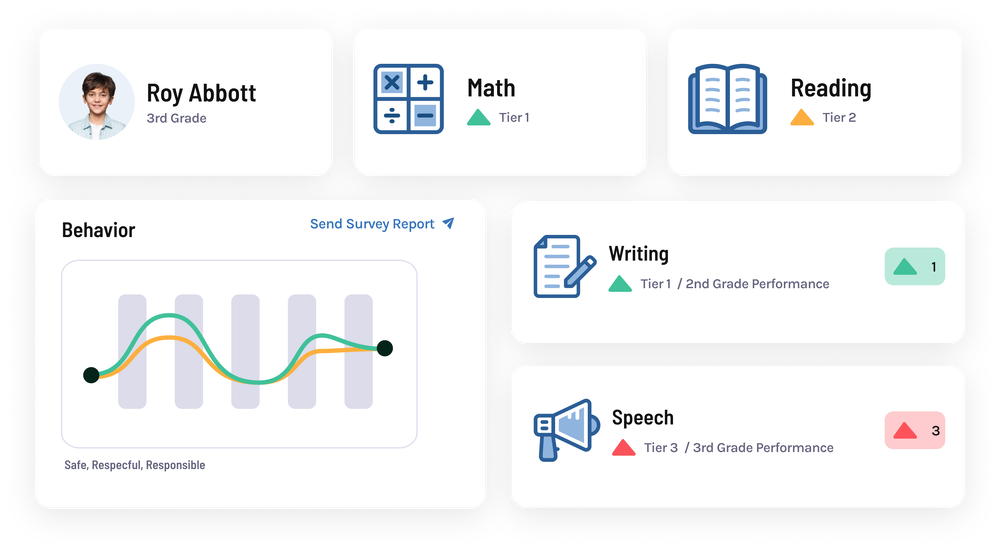
Reading Achievement Starts With a Strong MTSS Foundation
For each important aspect of early literacy growth in MTSS, Branching Minds makes the work more practical and sustainable.

.png?width=716&height=522&name=HB%20605%20and%20School%20Safety%20NC%20(preview).png)
.png?width=716&height=522&name=Understanding%20Literacy%20Basics%20(Preview).png)
.png?width=716&height=522&name=Georgia%20Literacy%20(preview).png)