































.png?width=444&height=266&name=Student-support%20(1).png)



.png?width=318&height=279&name=Evanston(tile).png)



.png?width=318&height=279&name=Teams%20Edweb%20(6).png)

%20(1).png?width=318&height=279&name=New%20Wave%20of%20State%20Mandates%20Pushes%20K-12%20Districts%20Toward%20Integrated%20Student%20Safety%20and%20Support%20Software(preview)%20(1).png)




.png?width=1436&height=956&name=7%20Guiding%20Principles%20of%20RTIMTSS%20(1).png)
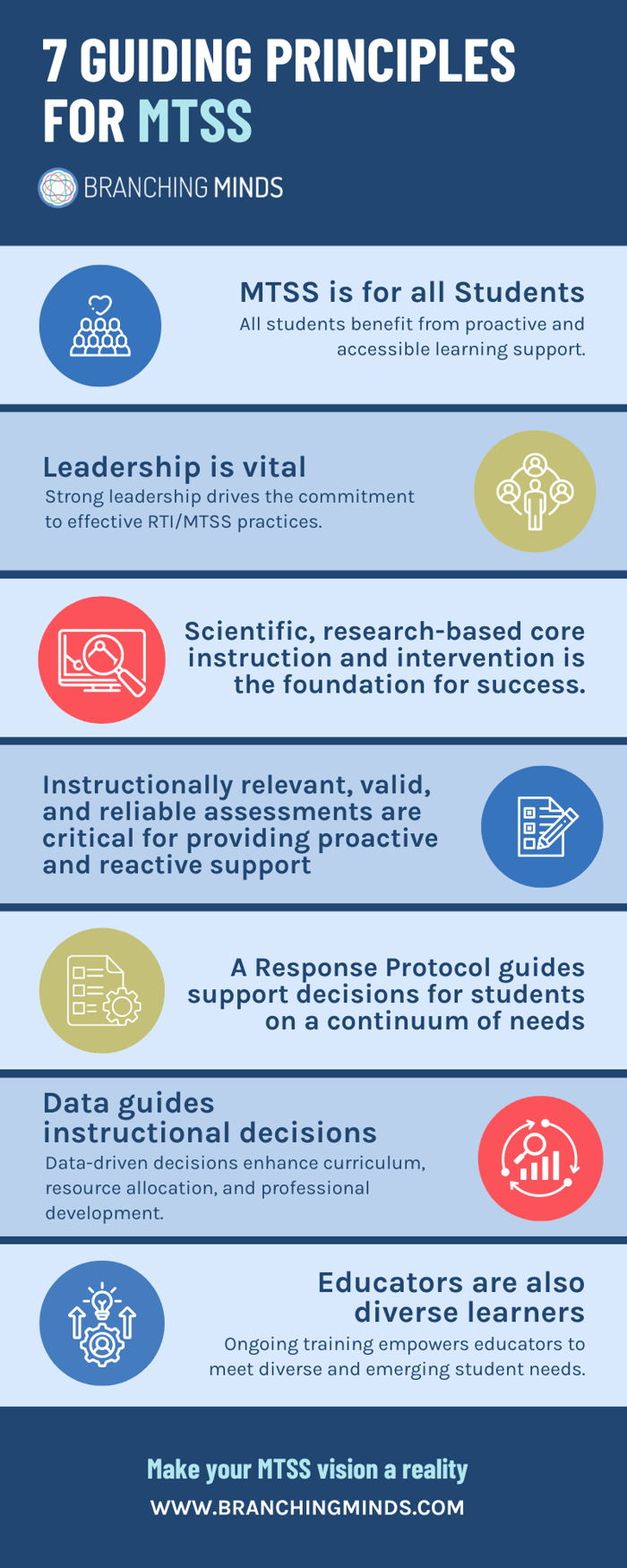
At Branching Minds, we believe that there are 7 guiding principles of MTSS:
1. MTSS is for ALL students.
-
Educators must work proactively to support students’ learning needs.
-
ALL students can learn.
-
ALL available resources are accessible to teach all students.
2. Leadership is vital.
-
Strong administrative support ensures clarity around protocol and commitment to time and resources.
-
Administration supports teachers by sharing the common goal of improving instruction (core, supplemental, and intervention).
-
RTI/MTSS team builds internal capacity and sustainability over time.
3. Scientific, research-based core instruction and intervention is the foundation for success.
-
Core Curriculum: To ensure students have the best chance at success, use strategies with a scientific, research base.
-
Core curriculum and instructional approaches must have a high probability of success for most students (80%).
-
Implementation of core curriculum must be verifiably implemented with fidelity.
-
-
Tiered Levels of Support: Beyond the core curriculum, match students’ instruction/support to the level and intensity of their need. The levels of support provided to students are based on increasing level of student needs, which is organized through a tiered framework:
-
Tier 1 is whole class core instruction
-
Tier 2 is whole class core instruction + additional targeted instruction (often small group)
-
Tier 3 is whole class core instruction + additional targeted instruction + intensive intervention
-
4. Instructionally relevant, valid, and reliable assessments are critical for providing proactive and reactive support.
There are 3 types of assessments, which vary in administration and use:
-
Summative assessments are administered to all students annually to determine students’ mastery of grade-level standards and provide educators with information about adequate yearly progress at site and district levels.
-
Universal screening assessments are administered to all students three times per year to proactively and objectively identify which students are potentially in need of educational supports / enhancements to supplement the core curriculum. Furthermore, evaluation of universal screening data is conducted to ensure the core curriculum is resulting in success for a sufficient percentage of students. These assessments should be nationally or state-normed and predictive of performance on summative assessments.
-
Progress monitoring assessments are given to students receiving intervention support and are administered weekly or every other week, depending on the intensity of need. These data should come from Curriculum-Based Measurements (CBMs), because they provide a reliable and valid measure of students’ growth in a particular skill area.
5. A Response Protocol is used to make support decisions for students on a continuum of needs.
-
A Response Protocol refers to the method and approach used when determining student needs and how to address them--it defines, “who gets what and when.”
-
The Response Protocol outlines a plan for using research-based, targeted interventions and enrichment services with increasing levels of cumulative support.
-
The Response Protocol outlines the roles and responsibilities of staff and clarifies the procedures and processes within the model (e.g., requirements to move a student into Tier 3, procedures for notifying parents, etc.).
-
There are three types of Response Protocols:
-
A Standard-Treatment Protocol (STP) is used when all students struggling with a similar area receive the same support plan.
-
A Problem-Solving Protocol (PSP) is used when a student receives an individual plan designed for their specific needs.
-
A combined approach (ST/PSP) uses elements from both protocols to design additional support.
-
6. Data guide instructional decisions.
-
Data are used to align curriculum and instruction to assessment.
-
Data are used to allocate resources.
-
Data drive professional development decisions.
7. Educators are also respected as unique learners.
-
Educators require professional development to ensure effectiveness and integrity at all levels of instruction.
-
Educators receive ongoing training and support to assimilate new knowledge and skills in a multitude of ways.
-
This support can be in the form of follow-up modeling and coaching.
-
This support can be provided in person, via webinar, in groups, one-on-one, through tutorials, articles, etc.
-
Educators anticipate and are willing to meet newly emerging needs based on student performance.
-
Learn more about how we can help

Strengthen MTSS Across Your District
See how the Branching Minds MTSS platform helps districts organize interventions, monitor student progress, and improve implementation across every school.

.png?width=716&height=522&name=What%20If%20Behavior%20Is%20the%20Key%20to%20Academic%20Success%20Mini%20Summit%20Recap%20(preview).png)
-1.png?width=716&height=522&name=Washingtons%20RTI%20Requirement%20for%20SLD%20Eligibility(preview)-1.png)
.png?width=716&height=522&name=MTSS-I%20NY%20(Preview).png)