





























.png?width=444&height=266&name=Student-support%20(1).png)




.png?width=318&height=279&name=Evanston(tile).png)


.png?width=318&height=279&name=Teams%20Edweb%20(6).png)

.png?width=318&height=279&name=Best_Small_Workplaces-2026(no-text).png)



.png?width=1945&height=568&name=Phoenix%20Elementary%20School%20District%20%231%20(AZ).png)
.png?width=1625&height=813&name=Phoenix%20Elementary%20District%20%231%20Improved%20Threat%20Assessment%20with%20Canopy%20%20(1).png)
%20(1).png?width=1000&height=500&name=Phoenix%20Elementary%20School%20District%20(thumbnail)%20(1).png)
"We trained on C-STAG on Monday, and on Tuesday we had what is now qualified as a very serious, substantive threat, the most serious category there is." Dawn Baumgartner, Coordinator of Social Services & Wellness, Phoenix Elementary School District #1, Phoenix, AZ.
For Dawn Baumgartner, who oversees threat assessment protocols for Phoenix Elementary School District #1, this work is not hypothetical. You don't get to choose when a real case shows up, only whether your team is ready when it does.
About two years ago, Dawn took on responsibility for threat assessment protocols at Phoenix Elementary District — a district serving 5,000+ students across 12 schools in downtown Phoenix. What she inherited was a district rooted in a prevention-first philosophy, emphasizing belonging and early intervention, but lacking the structured systems needed to bring that vision to life.
Over the past few years, Dawn and her team have worked to find the right protocol for school safety. Their goal: make the process of addressing student crises less burdensome, so that the students who need support most can actually receive it.
The Challenge: An Overworked and Disjointed System
When Dawn took over threat assessment protocols, she inherited a process that made every case harder than it needed to be:
- One-size-fits-all assessments — every threat, regardless of severity, required the same full, long, tedious assessment.
- Scattered documentation — records lived on pen and paper, in file cabinets, on outdated non-evidence-based forms, or in Google Docs, with no single, secure system.
- Constant troubleshooting — Dawn regularly fielded calls about what to do, where to find forms, or how to share information with the team, often in the middle of high-stakes conversations with students.
- Slower support — the process cost the team time and delayed support for the students who needed it most.
- No way to triage — without an easy way to gauge severity, staff sometimes overreacted to lower-level cases, pulling attention away from the ones that needed it most.
Recognizing the need, Dawn pulled together a multidisciplinary team of principals, social workers, school psychologists, and behavior specialists to evaluate different school safety protocols. The team landed on the Columbia Suicide Risk Screener and CSTAG (Comprehensive School Threat Assessment Guidelines). When Dawn was introduced to Branching Minds Canopy Case Management, she knew it was exactly what her team needed.
Learn more about building an effective team in our blog, 3 Things School Safety Teams Need to Be Effective.
The Result: Less Noise, More Follow-Through
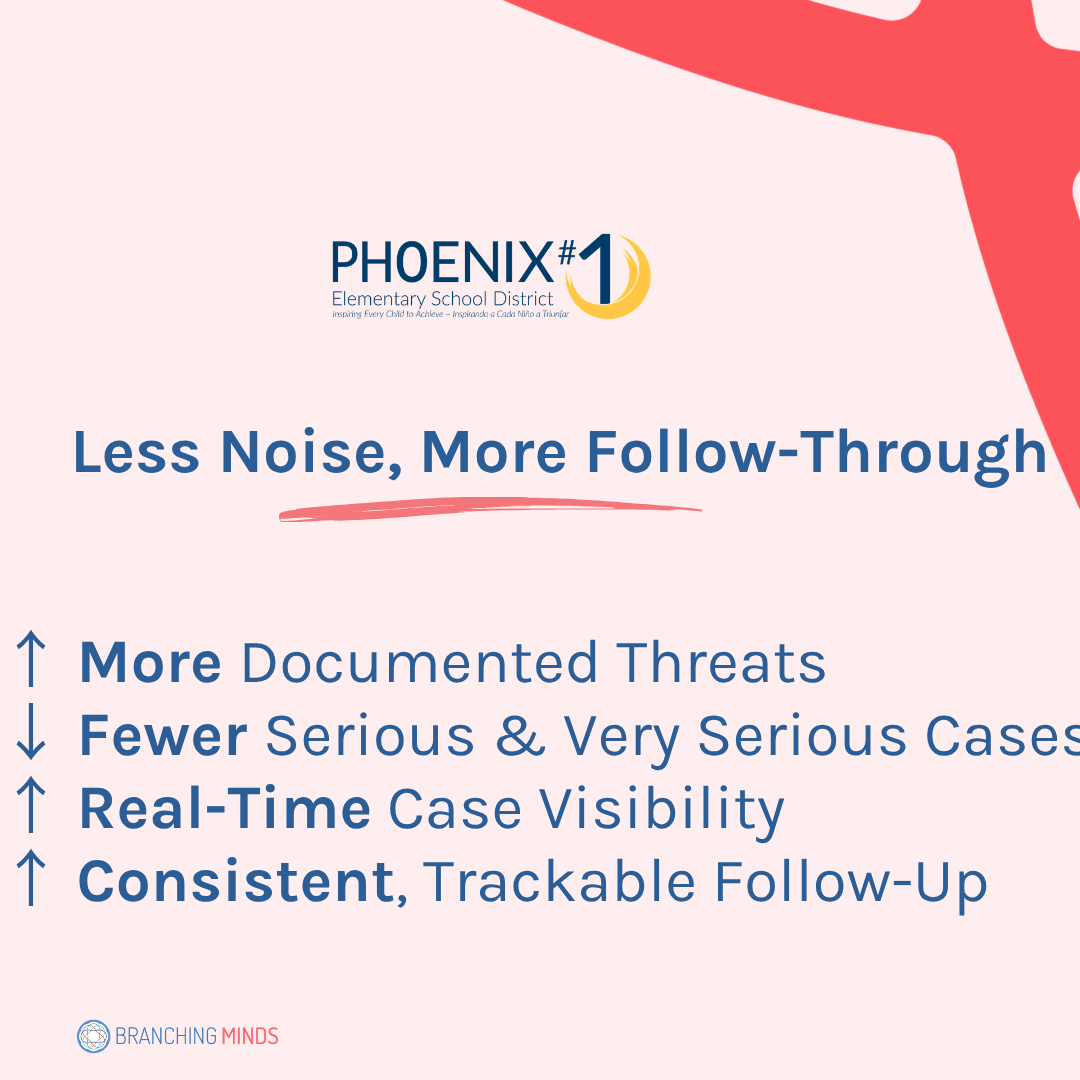
A year into using CSTAG and Branching Minds Canopy Case Management, they have experienced a positive shift:
- Less phone tag, more visibility. Staff can see documentation as it’s entered, so the team doesn’t have to track down where a case stands. They can see progress in real time.
- More consistent follow-through. The team can now generate and track follow-up tasks, so cases that used to fall through the cracks once a crisis stabilized get checked on instead of forgotten.
- A clearer, calmer picture district-wide. A full year of data showed more documented threats overall, but far fewer classified as serious or very serious — helping counter the perception that the district was facing a constant crisis.
- Freed-up emotional bandwidth. The CSTAG protocol and Canopy platform together reduced overreaction and gave teams more capacity to meet students’ actual needs.
That's the shift the team at Phoenix Elementary set out to make several years ago: a district built on belonging and early intervention now has the systems to match its mission. Their teams spend less time managing paperwork and more time showing up for students.

⬆️ Hear more from Dawn on her podcast episode, Creating Safe Schools: The Role of MTSS.

.png?width=716&height=522&name=Springs-Charter-Success%20(4).png)
%20(4)-1.png?width=716&height=522&name=Encinitas%20Union%20School%20District(Success%20Story)%20(4)-1.png)