































New Guide for District Leaders: Connecting MTSS, RTI, and Special Education
  • By role

    By Need

  • PRODUCT HIGHLIGHTS

    PARTNERSHIP

  • Spotlight

    Savings

  • Learn

    EVENTS

By role

By Need

PRODUCT HIGHLIGHTS

PARTNERSHIP

Spotlight

Savings

Learn

EVENTS

Your MTSS answers, one search away.

    Request a demo

    Threat Assessment and Suicide Risk Screening

    See how a standardized system for behavioral threat assessment and suicide risk screening can help your district protect and support students.

    School Safety

    School Safety:
    What District and Campus Leaders Need to Know

    Behavioral threats and warning signs call for a clear process that tells your team how to evaluate the concern, how to respond, and what support the student needs next.

    Strong school safety systems standardize that response with consistent behavioral threat assessment, consistent suicide risk screening, and a clear path from evaluation to support.

    Whether you're building a behavioral threat assessment process, rolling out suicide risk screening, or strengthening your district's school safety software and protocols, the resources below will help your team connect the pieces.

    On this page you'll find:

    Threat-Assessment

    Build a Safer, More Connected MTSS Framework

    Explore practical guidance for integrating threat assessment and suicide risk screening into one coordinated system of student support.

    A Core Part of School Violence Prevention

    What Is Behavioral Threat Assessment?

    🛡️ Behavioral threat assessment is a structured process for evaluating a report or expression of concern involving potential violence, and determining what response — if any — is warranted.

    Build a Stronger Behavioral Threat Assessment Process

    A threat assessment process typically involves:

    Student information

    Gathering information from the student, staff, and available records

    context

    Weighing context and intent — not just the words used

    Classifying the concern

    Classifying the concern as transient (not serious) or substantive (indicating real intent to harm)

    immediate safety planning

    Determining next steps, from no action needed to immediate safety planning
    Why it's different from discipline: Discipline asks what rule was broken and what consequence fits. Threat assessment asks a different question — what's actually going on with this student, and how substantive is the threat? A student who makes an alarming comment out of frustration and a student with a specific, credible plan to harm someone are not the same case.

    Threat Assessment Mythbuster

    Myth: Zero tolerance policies keep schools safer.


    Reality: Research shows zero tolerance approaches fail to distinguish serious threats from impulsive behavior and erode the trust that leads students to report concerns in the first place. Zero-tolerance policies apply the same consequence regardless of context or intent. Threat assessment does the opposite — it uses a structured protocol to understand context and intent so the response fits the situation

    The Role of CSTAG

    The Comprehensive School Threat Assessment Guidelines (CSTAG), developed by Dr. Dewey Cornell, give teams a validated five-step model for making that distinction and responding in a way that's proportionate to what's actually happening.

    Why your threat assessment team should be multidisciplinary: No single role has the full picture of a student's behavior, history, and needs.

    An effective team typically includes:

    • A school administrator
    • A school mental health professional (counselor, psychologist, or social worker)
    • A school resource officer or law enforcement liaison, where available
    • Other staff who know the student well
    MTSS Mini summit 2026 stacked_(tile)-1

    Webinar

    MTSS Mini Summit 2026: Behavior Across K–12

    📆 Jun 3, 12:00 ET

    Educators from across the country came together to explore practical strategies for strengthening behavior ...

    3 Things School Safety Teams Need to Be Effective | Branching Minds

    Article

    3 Things School Safety Teams Need to Be Effective

    Learn three practical strategies for building effective school safety teams, from multidisciplinary collaboration to coordinated follow...

    03.25.26_WEB_26_Building_Systems_to_Support_Student_and_School_Safety(tile)

    Webinar

    District Panel: Building Systems to Support Student and School Safety

    📆 March 25, 1:00 ET

    District leaders shared practical strategies for strengthening suicide risk and behavioral threat assessme...

    Featured Podcast
    How to Integrate Behavioral Threat Assessments into your MTSS.
      42 min
    How to Integrate Behavioral Threat Assessments into your MTSS.
    Schoolin' Around
    Play

    What Is Suicide Risk Screening?

    Suicide risk screening is a structured process for evaluating a student's risk of suicide when a concern has surfaced — through a disclosure, a referral, a behavioral change, or a pattern staff have noticed. It's typically administered by a school mental health professional or trained staff member in response to that concern, not as a blanket questionnaire given to every student.

    Screening asks a focused, consistent set of questions to gauge how serious that risk is. It isn't a diagnosis, and its value is in giving staff a reliable, structured way to respond to a concern that's already been raised.

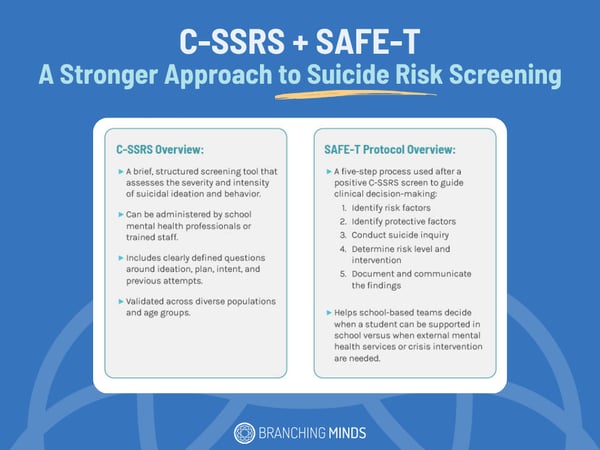
    The Columbia Suicide Severity Rating Scale (C-SSRS) is the most widely used tool for this work in schools — a brief, structured set of questions about ideation, plan, intent, and prior attempts, administered by a school mental health professional or trained staff member.

    C-SSRS and the SAFE-T framework

    C-SSRS and the SAFE-T framework are used together, not as separate steps.

    SAFE-T's five-step process incorporates C-SSRS's questions directly into how it identifies risk and determines next steps:

    1. Identify risk factors (drawing on C-SSRS ideation and behavior questions)
    2. Identify protective factors
    3. Conduct a suicide inquiry (using C-SSRS's structured questions)
    4. Determine risk level and intervention
    5. Document and communicate finding

    How Threat Assessment and Suicide Risk Screening Fit Into MTSS

    Threat assessment and suicide risk screening are most effective when they aren't treated as separate from a school's larger system of student support.

    Behavioral Threat Assessment Suicide Risk Screening

    Behavioral Threat Assessment & Suicide Risk Screening

    Evaluate specific concerns using structured protocols —such as the CSTAG and C-SSRS + SAFE-T — to determine the seriousness of a concern and the right immediate response.
    MTSS Behavior Supports

    MTSS & Behavior Supports

    Provide the ongoing academic, behavioral, and social-emotional infrastructure — Tier 1 expectations, Tier 2 groups, Tier 3 individualized plans — that address the needs a threat or risk concern often reveals.
    When these systems are connected, a team can move directly from evaluation to action:

    • A Tier 2 response — small-group counseling, check-in/check-out — for a student whose concern was determined transient
    • A Tier 3 re-entry plan with frequent progress monitoring for a student returning from a higher-risk situation
    • Family communication built into the plan, not handled as an afterthought
    After the Assessment What Comes Next

    ⬆️ Watch to learn what happens after a threat assessment is completed, how MTSS picks up where evaluation leaves off, and why keeping threat assessment and MTSS teams connected (rather than running on separate tracks) ensures students get the support they actually need.

    Why Disconnected Systems Fall Short

    A concern gets assessed, documentation goes in a file, and the student returns to class without anyone connecting what the assessment revealed to what they actually need day to day.

    Featured Resources
    From Compliance to Connection: What True School Safety Really Means

    Webinar

    From Compliance to Connection: What True School Safety Really Means

    📆 April 29, 1:00 ET

    In partnership with Sandy Hook Promise, this webinar explores how safety is strengthened when schools move...

    Behavioral Threat Assessment Integrating CSTAG into MTSS

    Article

    Assessing Threats and Preventing Danger in Schools: A Multi-Tiered Process

    Learn how behavioral threat assessment and the CSTAG framework help schools identify concerns early, strengthen MTSS, and create safer ...

    Behavioral Threat Assessment Webinar

    Webinar

    Integrating Behavioral Threat Assessment into Your System of Supports

    School safety starts with discernment and prevention—the ability to identify concerning behaviors, prevent escalation, and respond with...

    Support, Not Just Crisis Response

    Alignment between safety and MTSS teams promotes continuity, reduces duplication, and ensures that students experiencing distress are supported holistically, not just managed through a crisis response.

    Building a Strong School Safety System

    A defensible school safety process depends on having clear protocols and using them consistently across every school in the district.

    Standardized Documentation

    Standardized Documentation

    Every school follows the same threat assessment documentation and workflow, using consistent protocols instead of a patchwork of paper files and one-off systems.

    Consistent Decision-Making

    Consistent Decision-Making

    Structured protocols like CSTAG and C-SSRS + SAFE-T reduce the variability that comes from relying on individual judgment alone.
    Collaboration

    Collaboration

    Clear, permission-based access lets multidisciplinary teams collaborate on a case without compromising confidentiality.

    Districtwide Accountability

    Districtwide Accountability

    A centralized case record and follow-up task tracking, so nothing falls through the cracks.

    A dedicated school safety software platform brings these four pillars together in one place, so your team isn't stitching together spreadsheets, shared drives, and paper files to stay compliant.

    Location

    Phoenix Elementary School District #1, AZ

    "Before Canopy, things were a hot mess. We were originally using pen and paper, and a hodgepodge of different strategies and outdated documents that weren't evidence-based. Now, we're all trained in the CSTAG protocol, and our teams love having the decision tree pop up in Canopy to guide them through evaluations.

    From a district perspective, what's most helpful is I can monitor things on an ongoing basis — new or open cases, task follow-up, and trends. Canopy just releases some of our cognitive load so we can really meet the needs of our students."

    Dawn Baumgartner

    Coordinator of Social Services & Wellness

    standardizing student safety assessments (thumbnail)
    Featured Podcast
    Creating Safe Schools: The Role of MTSS
      32 min
    Creating Safe Schools: The Role of MTSS
    Schoolin' Around
    Play

    FAQs about Threat Assessment and Suicide Risk Screening

    Not necessarily. The goal is to assess the seriousness of the threat, understand what's driving a student's behavior, and respond appropriately. Research has found that using the CSTAG is associated with fewer suspensions and expulsions and more students receiving appropriate behavioral support.

    Requirements vary by state. A growing number — including Virginia, Florida, Texas, and North Carolina — mandate threat assessment teams, and several others require formal suicide prevention and intervention policies. Check your state's specific requirements, since timelines and scope differ.

    A transient or low-risk concern often leads to a Tier 2 response, such as a check-in/check-out plan. A substantive or high-risk concern triggers immediate safety planning, family notification, and often a Tier 3 re-entry plan once the student returns to school.

    The SAFE-T framework — which incorporates the C-SSRS's structured questions — guides the team through identifying risk and protective factors and determining whether the student can be supported at school or needs external mental health or crisis services. Either way, follow-up support and progress monitoring continue well past the initial evaluation.

    See How Districts Build Safer Schools

    What Connected Student Support Looks Like in Practice

    ⬇️ See how Evanston-Skokie School District 65 moved from fragmented safety processes to connected systems that support threat assessment, intervention, and student success.

    Screenshot 2025-11-10 at 3.02.12 PM

    Success Story

    How Beaumont ISD Improved Alternative School Collaboration with Branching Minds

    Read more

    "Bringing all departments together through Branching Minds showed how each role fits into supporting students and why everyone’s expertise matters."

    Products / Features Used

    How Beaumont ISD Improved Alternative School Collaboration with Branching Minds

    Success Story

    How “Know Every Student” Became a Reality at Springs Charter Schools

    Read more

    "Once we could see the whole child in one place, we could finally identify what students really needed."

    Products / Features Used

    Springs Charter Schools using MTSS to centralize student data and reduce suspensions with Branching Minds

    Success Story

    How CCSD 59 Flipped Its Triangle and Transformed Student Support

    Read more

    "The systemic change had a huge impact on morale, teacher confidence, confidence in what they’re doing, our collaborative practices as a team, and how we support students."

    Products / Features Used

    Community Consolidated School District 59 and Branching Minds

    Strengthen School Safety With Connected Student Support

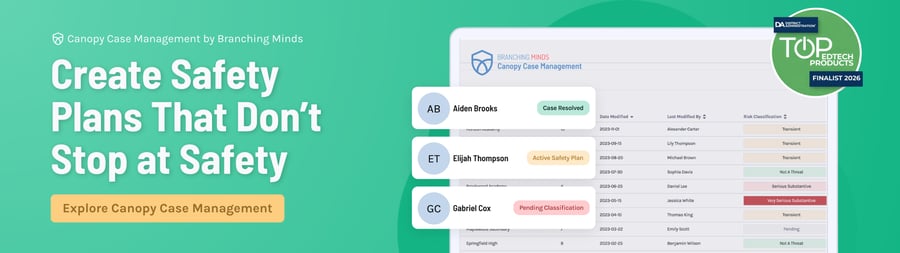
    Branching Minds Canopy helps your team assess students who may be at risk of harming themselves or others, and track how those concerns are being documented, escalated, and resolved — across every school in your district.

    Location

    Teton County School District, WY

    Canopy is well built in terms of steps - walking administrators through the process of doing suicide and behavioral threat assessments, so we are gathering all of that data into a single, secure place, where it can be referenced by those that need it in the future.

    Stephen Prange

    Director of Data, Assessment, and Mathematics

    See how Branching Minds supports safer schools. Bring threat assessment, intervention, and MTSS workflows together in one connected platform designed for K-12 schools.
    🎥 Watch Canopy in Action

    Create Safety Plans That Dont Stop at Safety - Canopy CTA Banner