
































.png?width=444&height=266&name=Student-support%20(1).png)



.png?width=318&height=279&name=Plainview(thumb).png)




.png?width=318&height=279&name=Teams%20Edweb%20(6).png)

%20(3).png?width=318&height=279&name=Mitch-CEO(preview)%20(3).png)



NEW YORK, NY — July 28, 2026 — Branching Minds, a leading K–12 education technology company that helps districts scale a Multi-Tiered System of Supports (MTSS), has launched Canopy Case Management — dedicated software for behavioral threat and suicide risk assessment that connects directly to a district’s broader system of student support.
%20(1).png?width=500&height=500&name=New%20Wave%20of%20State%20Mandates%20Pushes%20K-12%20Districts%20Toward%20Integrated%20Student%20Safety%20and%20Support%20Software(preview)%20(1).png)
A Growing Patchwork of State Mandates
Canopy arrives as more states are requiring schools to formalize how they evaluate and respond to students who may be at risk of harming themselves or others. Some states, like California and Washington, are focused on suicide prevention, intervention, and postvention policies or plans. Others are focused on behavioral threat assessment (BTA) teaming and policies, such as:
- Georgia (HB 268, Ricky and Alyssa’s Law): every public school must have a BTA management plan by January 2027.
- Illinois (105 ILCS 128/45): every district must establish a threat assessment team and a board-adopted procedure for targeted violence, and - as of 2025 - immediately report gun possession or threats of gun violence.
- North Carolina (HB 605): every public school unit must establish a threat assessment team following Center for Safer Schools guidance.
- Texas (Education Code §37.115 / SB 11): every district must convene a Safe and Supportive School Program team to conduct behavioral threat assessments.
Yet mandates tell only part of the story. Rates of suicidal ideation and suicide attempts remain high among high school students and are rising among preteens. BTA has become standard practice in U.S. schools, yet many educators still report challenges with inconsistent evaluations and follow-up. For district leaders, the open question is no longer whether to assess behavioral threats and suicide risk, but how to do it in a standardized way that ensures long-term, holistic support for students.
National Guidance Encourages BTA and MTSS Integration
In 2025, the U.S. Secret Service National Threat Assessment Center (NTAC) and the Center on PBIS jointly published guidance on aligning behavioral threat assessment with MTSS, concluding that integrating the two frameworks streamlines processes, strengthens data collection, and leads to better outcomes for students and staff. The National Association of School Psychologists (NASP) takes a similar view, describing threat assessment as one component of a comprehensive, multi-tiered approach to school safety — not an isolated security function.
The goal isn’t just to evaluate a threat; it’s to understand what a threat reveals about a student’s underlying needs and then respond with targeted support. That is the gap Canopy was designed to close.
“When a threat is credible, we need to respond quickly — in coordinated ways that follow best practices. But threats deemed not credible still hold meaningful signal that students need some level of support,” said Maya Gat, CEO and Co-Founder of Branching Minds. “Ignoring that signal now could result in more substantive threats in the future. We want to help districts build a system where student safety and support are truly connected, so staff can respond to student needs with the right level of support, as soon as they need it. Canopy was built to bring that integration into everyday practice.”
How Canopy Helps Districts Meet This Moment
Canopy gives safety teams a centralized, secure environment to document behavioral threat and suicide risk assessments:
- A centralized view of open and historical cases, risk classifications, and outstanding actions across every building
- Built-in, evidence-based protocols
- Guided workflows that help teams make consistent decisions
- Task management that supports clear ownership
- Response planning and tracking
- User-based permissions, FERPA-compliant confidentiality protections, and SOC 2 Type II-certified security
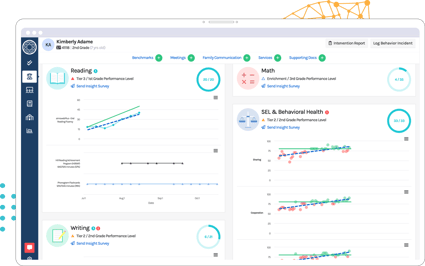
Canopy is unique in its native integration of threat assessment, suicide risk screening, and MTSS. When used alongside the Branching Minds MTSS platform, student data — across academics, attendance, behavior, and interventions — can easily be used to inform a threat or suicide risk assessment. And, evaluations can flow directly to behavioral and social-emotional intervention plans, which can be monitored by relevant staff.
“Canopy is doing for us in school safety what the Branching Minds MTSS platform did for us years ago,” said Dr. Katie Ahsell, Assistant Superintendent of Student Services and Support in Community Consolidated School District 59 in Illinois. “It lets us view safety data alongside behavior details for a more complete picture of student needs. By centralizing threat and suicide risk assessments and making follow-up actions visible, we can evaluate risk holistically and respond more proactively across the district.”
Canopy can be used as a standalone solution or directly integrated with the Branching Minds MTSS platform, already used by hundreds of districts nationwide. Canopy Case Management was also named a finalist for the 2026 Top EdTech Products of the Year Awards in Safety and Security Technology. To learn more, visit www.branchingminds.com/student-safety-software.
About Branching Minds
Branching Minds is a comprehensive data analysis and student support platform. Bringing together academic, behavior, attendance, safety, and intervention data in one place, Branching Minds provides educational leaders with a complete view of student needs and system performance, and makes it simple for teams to document intervention plans.
Since 2013, Branching Minds has collaborated with nearly 300,000 teachers and 545 districts across 38 states, improving outcomes for more than 2 million students. Learn more at www.branchingminds.com
Suicide and self-harm are sensitive topics. If this release will be shared with anyone who may be personally affected, note that the 988 Suicide & Crisis Lifeline (call or text 988) is available 24/7 in the U.S.

Abigail Woodworth
media@branchingminds.com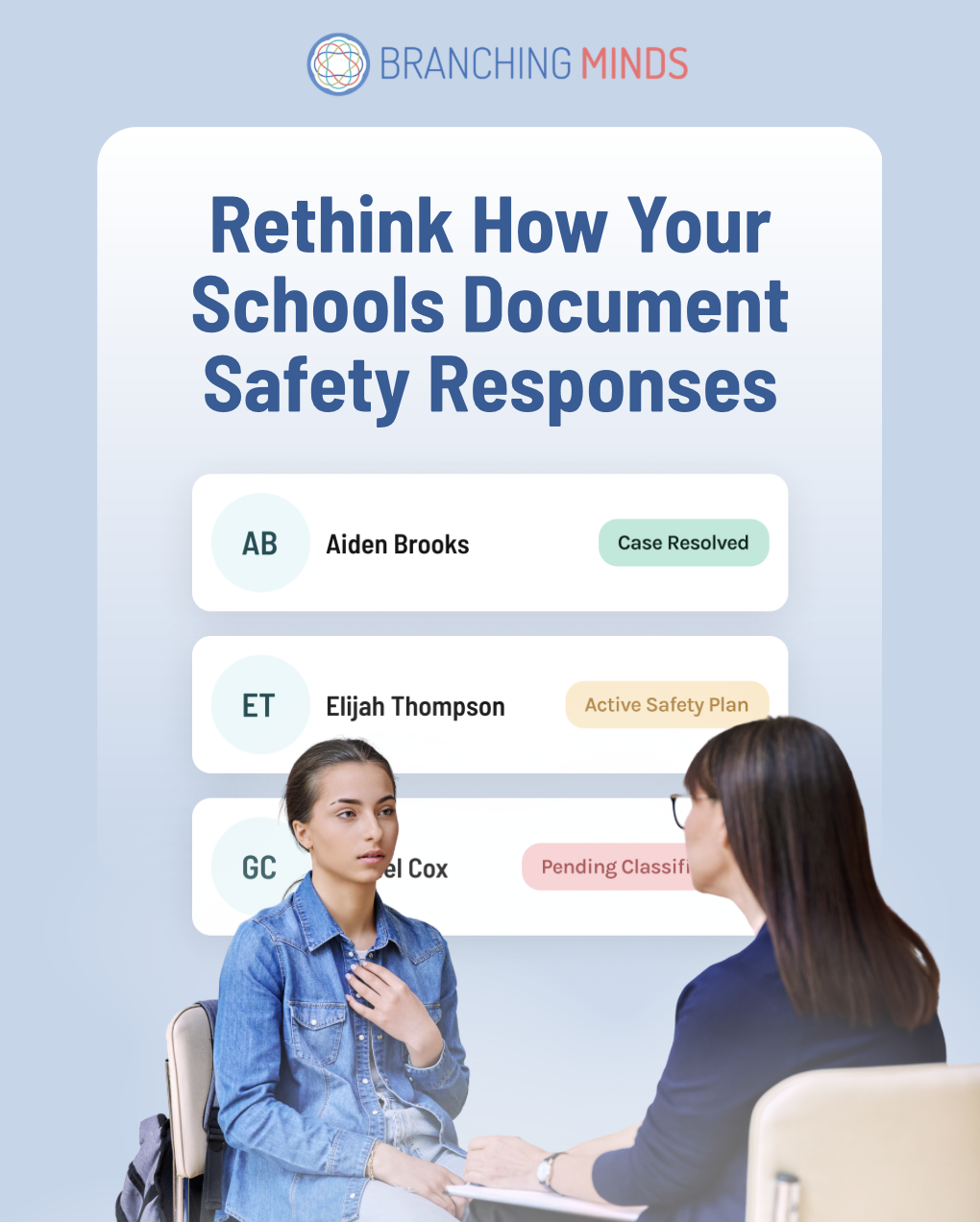
Safety Insights to Support Every Student
Bring threat assessment, suicide risk response, and student support planning together in one secure system.
.png?width=716&height=522&name=Branching%20Minds%20Named%20Finalist%20for%20Multiple%202026%20CODiE%20Awards(Preview).png)
.png?width=716&height=522&name=Branching%20Minds%20Wins%20Two%202026%20CODiE%20Awards%20for%20Best%20Collaborative%20Solution%20for%20Teachers%20and%20Best%20Productivity%20and%20Workflow%20Tool%20for%20Teachers(Preview).png)