


































.png?width=444&height=266&name=Student-support%20(1).png)




.png?width=318&height=279&name=Evanston(tile).png)



.png?width=318&height=279&name=Teams%20Edweb%20(6).png)






.png?width=1436&height=956&name=HB%20605%20and%20School%20Safety%20NC%20(preview).png)
North Carolina's House Bill 605 requires every public school to have a threat assessment team. The mandate is clear: evaluate potential threats, document each step, and determine what comes next.
Many districts have built that process, and for those already operating within a Multi-Tiered System of Supports (MTSS), the infrastructure needed for follow through is already familiar. For others, the question is how to make threat assessments more accurate, connect students with safety concerns to the right support, and maintain continuity when students move between schools.
Whether your district is early in its MTSS journey or has years of implementation behind it, there's real value in understanding how your MTSS framework and threat assessment process can be better aligned.
Meeting the Requirement and Making It Work
HB 605 was designed to help North Carolina schools take a more structured, evidence-based approach to student safety. By using trained, multidisciplinary teams and consistent protocols, schools can better distinguish between a student experiencing a genuine crisis and one reacting impulsively — leading to more informed decisions and appropriate follow-up.
MTSS provides the framework to support that work. Districts with strong MTSS systems already have many of the key elements in place:
-
Collaborative teams
-
Shared data
-
Documentation processes
-
Ongoing student assessment and support
Related Resource: See how a strong MTSS framework can help North Carolina districts improve student support and decision-making. Download The Ultimate Guide to MTSS.
A Threat Is Almost Always a Signal
The U.S. Secret Service's National Threat Assessment Center found that in over 80% of school attack cases, warning signs were present beforehand. The challenge is ensuring schools have systems in place to see and act on those signals before a situation escalates.
When a student comes to the attention of a threat assessment team, it is commonly a student who is struggling with academic pressure, chronic absence, conflict with peers, a mental health need, or circumstances at home that have become unmanageable.
MTSS not only provides the context for student behavior, emphasizing on understanding the root causes of student behavior but is built to support.
What MTSS Brings to Threat Assessment
A Multi-Tiered System of Supports provides the architecture for coordinated, proactive student support across academic, behavioral, and social-emotional domains. When threat assessment is embedded within that architecture — rather than running alongside it — several things change.
- Teams have context. In districts with active MTSS implementation, teams regularly track attendance patterns, academic trends, behavioral incidents, and social-emotional screening results. When a safety concern surfaces, the threat assessment team doesn't have to start from scratch. The data is already there.
- Warning signs are visible earlier. Chronic absenteeism, academic disengagement, escalating behavioral incidents, or a drop in social-emotional scores are all data points that MTSS processes are designed to surface. They're also among the most common precursors to a serious safety concern. A well-functioning MTSS identifies distress while there's still time to respond meaningfully.
- Follow-up is connected, not siloed. One of the most significant challenges in standalone threat assessment is what happens after the initial evaluation. A concern is assessed, a plan is documented — and then the student returns to school, sometimes without a clear connection between assessment findings and the support they're actually receiving day to day. MTSS provides the connection: academic interventions, behavioral supports, counseling, and family engagement are all informed by what the assessment revealed.
Structured Teams and Evidence-Based Protocols
HB 605 calls for multidisciplinary threat assessment teams — and that structure reflects a core principle of MTSS: effective support for students with complex needs requires more than one perspective at the table.
An effective threat assessment team typically includes:
-
An administrator
-
A school mental health professional (psychologist, counselor, or social worker)
-
A school resource officer or law enforcement liaison
- Other relevant staff who know the student.
That same cross-disciplinary representation shows up in MTSS team structures, and for the same reason. No single role has the full picture. The team does.
Evidence-based protocols strengthen this work considerably. Tools like the Comprehensive School Threat Assessment Guidelines (CSTAG) provide a structured decision-making process for determining whether a threat is transient or substantive, guiding the team toward responses that are proportionate and support-oriented. Research on CSTAG has shown reductions in suspension rates, fewer racial disparities in discipline outcomes, and a greater likelihood that students receive appropriate behavioral supports.
For suicide risk, protocols like the Columbia Suicide Severity Rating Scale (C-SSRS) paired with the SAFE-T framework give teams a validated, structured process for assessing severity and determining whether a student can be supported at school or needs external crisis services.
These tools are built for school-based teams — structured guides that support consistent, defensible decisions with student safety and well-being at the center.

⬆️ Threat assessment and suicide risk protocols are most effective when they're part of a broader system of student support. In this podcast, you'll learn how MTSS helps schools bring prevention, intervention, and safety planning together.
The Drivers Behind Concerning Behavior — and How MTSS Helps Address Them
When a concern surfaces, the underlying factors tend to fall into recognizable patterns:
- Academic frustration — a student falling behind and losing confidence
- Chronic absenteeism — disengagement that often signals something bigger at home or at school
- Bullying or social conflict — isolation, retaliation, or a breakdown in peer relationships
- Mental health needs — anxiety, depression, or trauma that hasn't yet been connected to support
None of these show up in a single data point. They emerge across systems — in screener results, attendance records, behavior logs, and the observations of adults who know the student. MTSS is designed to bring those sources together so teams can see the fuller picture and respond to what's actually driving the concern, not just the presenting behavior.
From Assessment to Action: MTSS-Aligned Follow-Up
What happens after a threat assessment is just as important as the assessment itself. This is where an MTSS framework helps teams maintain momentum beyond the initial response.
When a threat is determined to be low-risk or transient, students often still benefit from support. The behavior may reflect a coping breakdown, an unmet social-emotional need, or an academic struggle that's been building for some time. A Tier 2 response — small-group counseling, check-in/check-out with a trusted adult, or targeted social skills instruction — addresses the underlying need and keeps the student connected to school.
When a threat is substantive or a student is at high risk of self-harm, the response is more intensive. Safety planning, family notification, and connection to external mental health services are immediate priorities. And they're the beginning, not the end. Students returning from a hospitalization or a period of suspension need a structured re-entry — a Tier 3 plan that includes individualized behavioral support, frequent progress monitoring, and coordination between school and community providers.
In both cases, the goal is consistent: ensure that the support follows the student, and that the adults around them are working from a shared plan.
When Students Move, Their History Should Too
Centralized, integrated documentation is one of the most practical ways MTSS supports what HB 605 requires. When threat assessment records, intervention plans, and behavioral history are part of a unified student support system, the receiving school has the context they need from the start. Critical warning signs don't get lost in the transition, and the next team isn't rebuilding the picture from scratch.

⬆️ In Orange County Schools, district leaders replaced disconnected processes with a unified MTSS system that provides the information they need to make timely, coordinated decisions and ensure student supports continue across schools. See how Orange County Schools strengthened student support through MTSS.
The Path Forward
At its core, HB 605 reflects something educators across North Carolina are already working toward: a more structured approach to school safety. Getting there requires the infrastructure to identify students early, respond with the right level of support, and maintain continuity across schools and school years.
For districts already implementing MTSS, much of that infrastructure is in place. Aligning it with threat assessment practice is often a matter of connection rather than construction. For districts still building, MTSS provides a clear and practical path toward making HB 605 work the way it was intended.
What strong implementation tends to look like in practice:
- Threat assessment and MTSS teams share key members and communicate regularly
- Safety concerns are evaluated through structured, evidence-based protocols
- Assessment findings connect directly to academic, behavioral, and social-emotional support plans
- Students at every risk level have a documented follow-up plan — not just those flagged as high risk
- Student records, including safety history, are maintained in a system that transfers when a student moves
Districts that build this kind of connected system are better positioned to meet the requirements of HB 605 — and to catch student distress sooner, respond more consistently, and make prevention a sustainable part of daily practice.
Support Safer Schools Across North Carolina
North Carolina districts are strengthening school safety by connecting threat assessment with MTSS. See how Branching Minds helps districts build coordinated systems that support HB 605 implementation and student success.

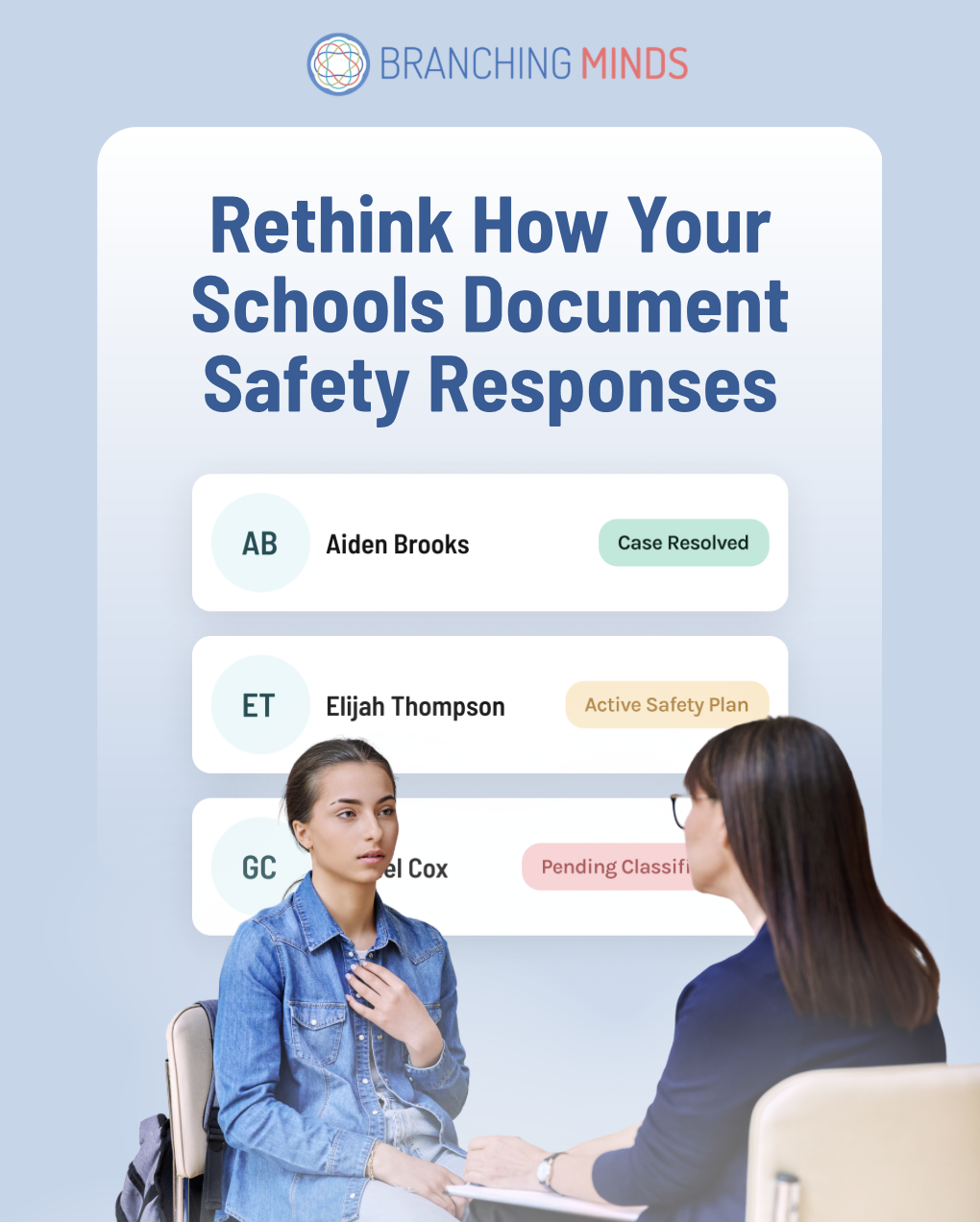
Safety Insights to Support Every Student
Bring threat assessment, suicide risk response, and student support planning together in one secure system.

.png?width=716&height=522&name=Georgia%20Literacy%20(preview).png)
.png?width=716&height=522&name=Reading%20Interventions%20(Preview).png)
.png?width=716&height=522&name=Understanding%20Literacy%20Basics%20(Preview).png)