














Over the past year, I’ve had remarkably similar conversations with district leaders in five different states. Even though each of these leaders has a different job title and different starting point, each one was working on student safety and shared that threat assessment is challenging without infrastructure and a clear process.
A district does not have the capacity to treat every concerning statement as an emergency, and there is a fine line between a case that needs a full safety plan and a student having a hard day. Both directions carry a cost. If you overreact, you exhaust the people doing the work, and if you underreact, you might miss a critical warning sign.
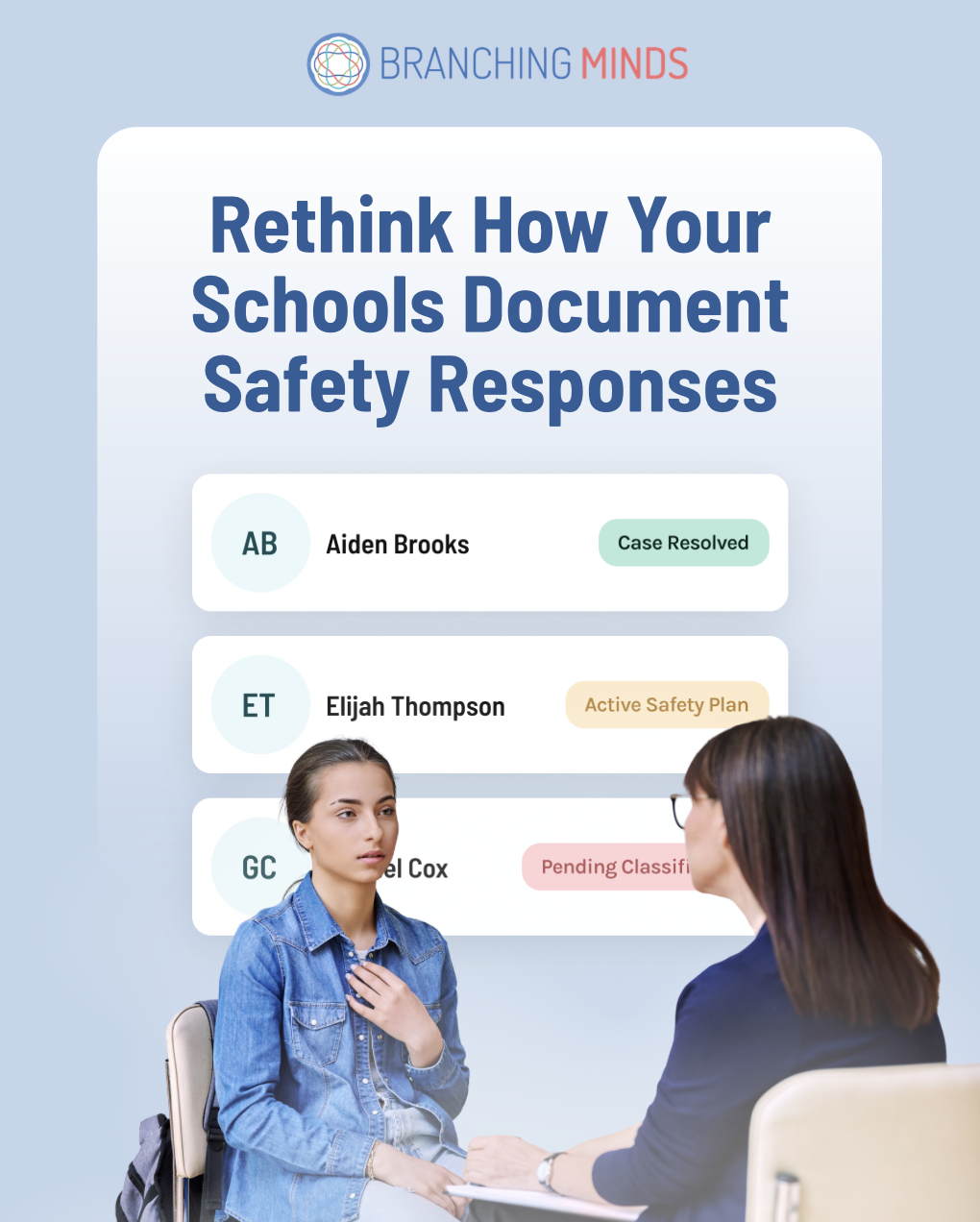
A structured protocol gives teams a standard way to tell the difference, along with clear next steps so nothing falls through the cracks. A shared place to do that work means the next person who needs that history can find it while the student is still sitting in the office, not after.
These are some of the common challenges without a structure to support teams.
- Safety assessments live apart from everything else. Forms and screening data sit in Google Drive folders, filing cabinets, or a standalone platform, while attendance, behavior, and intervention data sit somewhere else.
- The threat assessment ends the process and doesn’t lead to student support. A student is screened, a form is filed, and no one follows up with a support plan.
- There's no common language for what counts as a threat. Without it, staff fall back on their own experience — "I know that kid, they didn't mean it."
- Confidentiality and continuity pull against each other. Information about students should be confidential, but relevant information about support is useful knowledge that should travel with them.
- Nobody can see patterns. Without one place it is hard to see trends and patterns in events and student needs.
How to Integrate Threat Assessment into MTSS: Lessons from District Leaders
These five districts started at different points, and none of them would tell you the work is finished. What they have in common is their decision that they made before choosing a tool to make it easier.
- They chose an evidence-based framework. Most landed on the Comprehensive School Threat Assessment Guidelines (C-STAG), developed at the University of Virginia.
- They built a multidisciplinary team that includes mental health professionals, teachers, administrators, and in some cases school resource officers.
- They took time. One district spent a full year reviewing its own practice before selecting anything. Another slowed a rollout when staff raised concerns.
- They treated the threat assessment as a beginning. A transient or "not a threat" classification isn't a case closed. Follow up is needed and can help prevent future problems.
More than anything else, they connected safety work to the support system they already had. Threat assessment became part of MTSS rather than a parallel process run by different people.
The vast majority of student threats are never carried out, and only about 1% lead to law enforcement action. But roughly three out of four students who go through a threat assessment end up receiving a support service of some kind. When a student makes a threat, it is an indication that the student likely needs more than an initial assessment.
Phoenix Elementary School District #1, Arizona: Fewer Emergencies, More Support
Dawn Baumgartner is a licensed clinical social worker who oversees PBIS district-wide at Phoenix Elementary School District #1, and two years ago she took on her district's threat assessment protocols. Her teams were doing serious, careful work. They were also running the full threat management protocol on nearly every case that reached a desk, and it was more than the team could sustain.
The first step she took was building a team, so she brought together principals, directors, social workers, behaviorists, and psychologists and spent a year examining what was working and what wasn't. That process led them to C-STAG protocol for threat assessment and the Columbia Suicide Risk Assessment, and to documenting the work in Canopy Case Management.
The first year produced a result that sounds backward until you look closely.
Since then, the team has been trained on C-STAG, built a consistent follow-up process with students, and shared documentation in real time within Branching Minds Canopy Case Management.
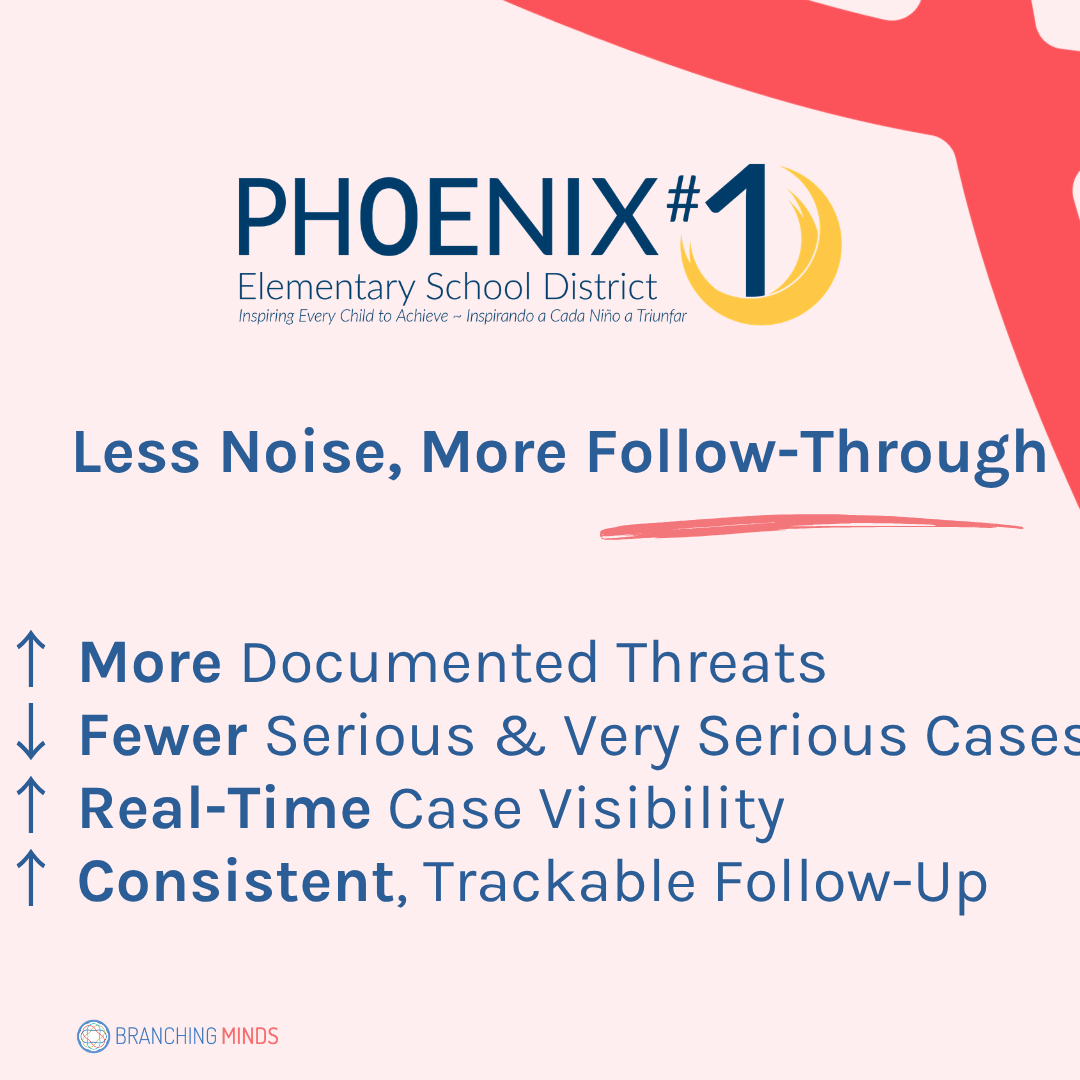
The consistency changed Dawn's work week.
The documentation went up and the pressure went down. This is what happens when you standardize a process with great tools.
Evanston-Skokie School District 65, Illinois: Build the Team, Then Give It Somewhere to Work
Evanston-Skokie School District 65 has built a strong MTSS foundation, and now is treating school safety as part of that system rather than something running parallel.
This starts with a school safety team in every building.
- The school leader, who serves on the team without always leading it.
- Social workers, psychologists, and middle school counselors, who conduct the threat and risk assessments as the district's trained mental health professionals.
- Classroom educators, including general education, special education, and multilingual teachers.
- Paraprofessionals, who interact with students in ways a principal or a PE teacher never will.
These teams meet at least monthly to review building-level climate and safety data, examining response calls, completed threat assessments, and students who have an SEL MTSS plan or might need one.
The essential part of District 65's success is that they fold this work into MTSS. They treat behavior and SEL needs the way they treat academics:
-
Identifying needs
-
Implementing interventions
-
Monitoring progress
-
Collecting the data utilizing Branching Minds Core Platform and Canopy Case Management for both.
Dr. Jessica M. Plaza, who spent about a decade as a principal before moving to the district office, points out that this lets staff address issues before they become something bigger.
"Leveraging Canopy Case Management for us has been really helpful because it all lives then in the Branching Minds system, which we already use for our behavioral incident referrals. We already use it for our MTSS plans. And so for us, keeping it as easy and centralized as possible has been — you know, it's very hard when you have to go to five different places to do one job."
Dr. Jessica M. Plaza, Director of Schools Management, Evanston-Skokie School District 65
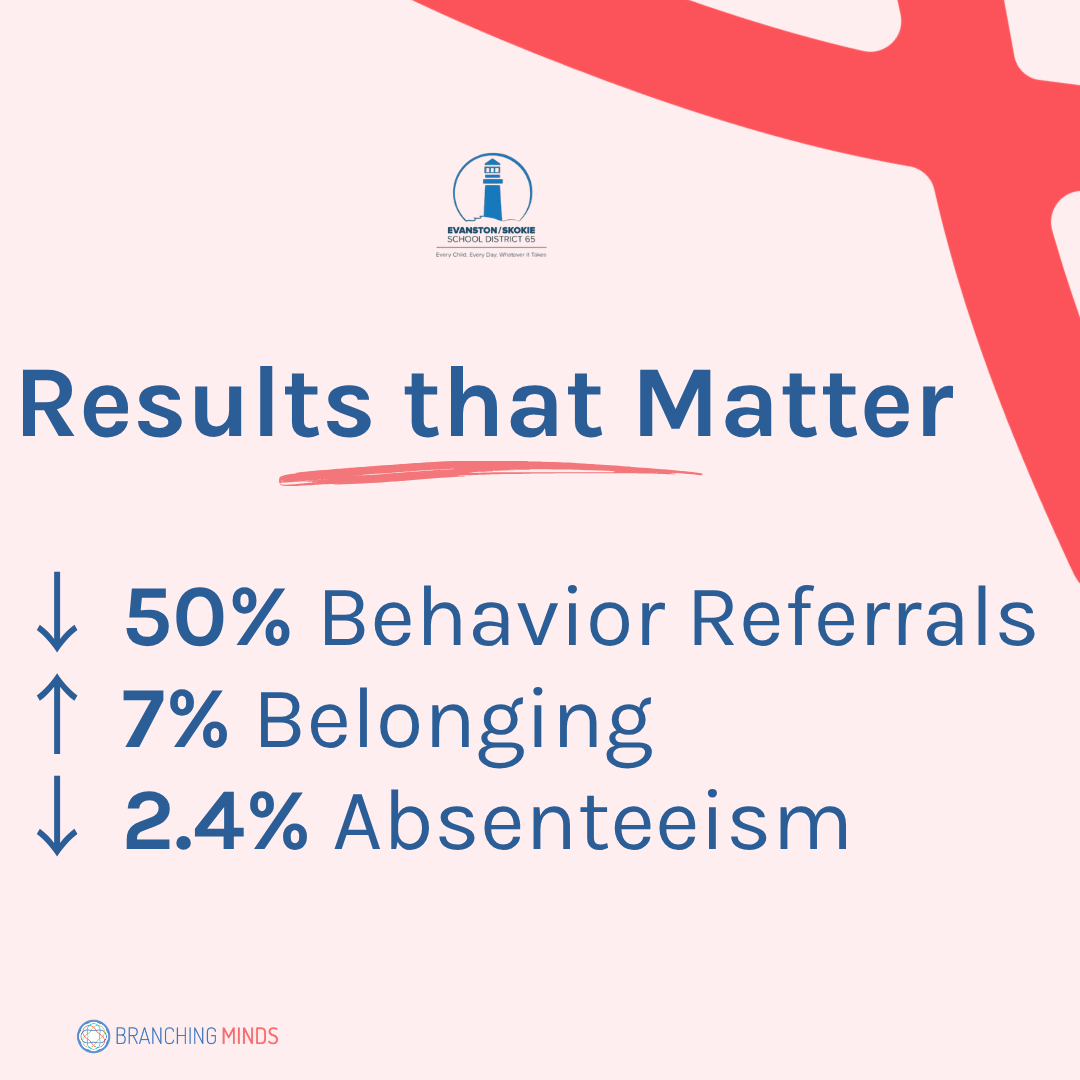
Over two years, the district saw a 50% reduction in level 3, 4, and 5 behavior incident referrals, a 7% increase in students' sense of belonging, and a 2.4% decrease in chronic absenteeism.
Related Resources:
-
Curious what makes a safety team work? See 3 Things School Safety Teams Need to Be Effective.
-
Watch District Panel: Building Systems to Support Student and School Safety with Dr. Jessica M. Plaza and Dawn Baumgartner, LCSW.
- Listen to Creating Safe Schools: The Role of MTSS featuring Dr. Jessica M. Plaza
-
Want a framework for turning warning signs into action? Get the guide: Integrating Threat Assessment and Suicide Risk Screening into MTSS.
Springs Charter Schools, California: The Protocols Were Right. The Collaboration Wasn't.
Springs Charter Schools is a network of eight charter schools across roughly 22 sites in four California counties, serving more than 13,000 students in settings that range from five days a week in person to full home school. With staff spread that wide, collaboration is the challenge.
Sarah Adams, Senior Director of Student Support Services, already had solid protocols in place and staff trained to use them. Her teams were running C-STAG and the Columbia Suicide Risk screener well. Documentation was the piece that wasn’t working. Assessments lived in different places, some on paper and some in the cloud, and getting the right people to the right notes took real work.
What Springs Charter did:
- They kept the protocols they already trusted.
- They rolled out the change as an opt-in in year one to avoid adding another mandate.
- They put all the documentation in one place with Canopy Case Management.
- They built in a cue for MTSS teams through a protected note on the student's profile, visible only to staff with a need to know, signaling there's more to consider without exposing sensitive detail.
- They started watching for patterns. A student with repeated suicide risk screenings and a threat assessment reads as one escalating need rather than a series of one-offs.
Sarah is also clear about where the protocol stops. "At the end of the day, it is the provider or the person doing the assessment — that's their call."

Community Consolidated School District 59, Illinois: Applying an Equity Question to Safety
In the middle of rebuilding core curriculum and reallocating intervention staff, Community Consolidated School District 59 in Illinois was asking its administrators a hard question: if a child goes to school A and receives support, then moves to school B and does not, are we okay with that? Everyone agreed they were not.
Dr. Katie Ahsell, who oversees MTSS, SEL, behavior, and school safety and security, started asking the same question about safety. The district was already using the Branching Minds core platform to examine academic practice. Safety was the piece that hadn't caught up.
"Canopy is doing for us in school safety what Branching Minds did for us years ago, which is it's giving us insight into what is happening across our district, where things are similar, where they're different, where we have areas of higher need, of lower need, and allowing us to re-evaluate from a lens of safety and student behavior that we've never done before."
Dr. Katie Ahsell, Assistant Superintendent of Student Services and Support, CCSD 59
Not everything they surfaced was comfortable. Buildings differed in what they chose to assess and in where they drew the line on what counted as a threat. Those differences had always existed, but now they are documented, and the district has what it needs to get its schools calibrated.
Dover School District, New Hampshire: Going Slow on Purpose
After several student crises, Dover School District took the standard crisis handbook off the shelf and rebuilt its approach to fit its local context and the initiatives already underway. Travis Bickford, Director of MTSS, is honest that they are still in the middle of that process. They began by training their own in-district C-STAG trainer and adopting Canopy Case Management.
Even though Dover is still at the beginning of the work, but the way they are going about it is instructive for other districts.
They are:
- Leading with the structured framework, chosen deliberately rather than purchased in response to an urgent need.
- Building in-district expertise through train-the-trainer, because initial training alone changes practice very little without embedded coaching.
- Training the whole leadership team, at the high school principal's insistence, so the district responds as one.
- Creating deliberate overlap between teams. The school psychologists, social workers, and deans who lead threat assessments also sit on building site intervention teams, so a safety concern and a support plan aren't handled by two different sets of people.
- Learning patience. Travis expects full implementation to take two to five years, and describes slowing down in order to go fast later.
Underneath all of it is a principle Travis says the district repeats, and a clear summary of this work.
Connecting Threat Assessment to Student Support: What a Shared System Makes Possible
None of these districts started by shopping for software. Each of them examined their practice first and asked what would make the work more consistent and less cumbersome for their teams. Travis described why this is so important.
But a team spread across several buildings cannot collaborate on the same PDF. A counselor cannot dig through a filing cabinet for a student's history while that student waits in the office. And an MTSS team cannot account for a safety concern it doesn't know about.
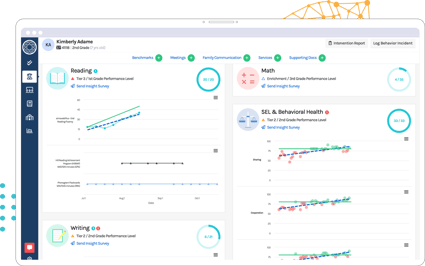
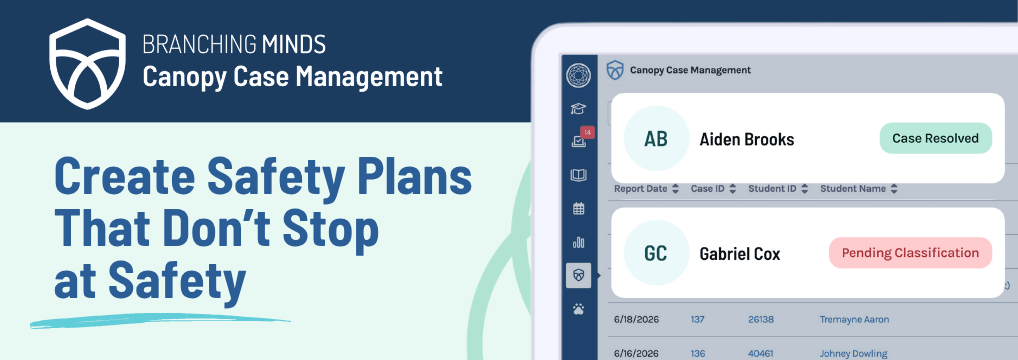
Canopy Case Management allows for:
- One clear place to start in high-stress moments
- Real-time collaboration on assessments, response plans, and assigned tasks
- Repeat concerns surfacing as patterns instead of unrelated incidents
- District-wide visibility for decision making
And when that work connects to the rest of the student's record:
- Your team can see a student's behavior, attendance, and support history while conducting the assessment, so a decision rests on context.
- The assessment hands off into tiered support, a documented need becomes a plan.
- MTSS and safety teams work from the same record, with confidentiality protected by permission.
- Building teams review climate and safety data next to academic and SEL screening data in one monthly conversation.
Getting Started with Threat Assessment in Schools: Next Steps for Any District
Each of these districts came at this work differently.
-
Dover is mid-transition from paper.
-
Phoenix centralized its safety work and has a full year of practice behind it.
-
Springs had trusted protocols and wanted them out of Google Drive.
-
CCSD 59 was looking district-wide at academics and wanted to do the same for student safety.
-
District 65 had built its school safety teams and wanted the data to go along with the work.
If you are early in this work, start with your people rather than your software. Look at who is on your safety team, whether they have a protocol they trust, and whether the adults who support that student every day can see what the team learned. That is the gap to close first.
Every one of these leaders told me their work is not finished, and I found that encouraging rather than discouraging. They are all still building, and their students are better supported for it.

Safety Insights to Support Every Student
Bring threat assessment, suicide risk response, and student support planning together in one secure system.