































.png?width=444&height=266&name=Student-support%20(1).png)




.png?width=318&height=279&name=Evanston(tile).png)



.png?width=318&height=279&name=Teams%20Edweb%20(6).png)

.png?width=318&height=279&name=Best_Small_Workplaces-2026(no-text).png)




.png?width=1436&height=956&name=Threat%20Assessment%20Process%20(preview).png)
Picture a school with flawless cameras, hardened entrances, a detailed discipline matrix, and a threat assessment protocol that meets every best-practice standard. But ... the students don't trust the adults. How safe is that school, really?
Every threat assessment protocol shares the same blind spot: it depends entirely on a report that hasn't happened yet. A protocol can't act on a threat no one reported. Michelle Sheane, Assistant Superintendent of Student Services at Springs Charter Schools, and Dr. Essie Sutton, Director of Learning Science at Branching Minds, walked through what has to be true on a campus before a report is ever made, and what a district still needs once it is.
.png?width=2100&height=1097&name=WEB_26_Strengthening_Threat_Assessment_Belonging_Discipline_MTSS_08.25.26(tile).png)
The Chain of Trust: What Has to Be True Before a Report Happens
Sheane's framework treats school safety as a chain with six links, and every adult on campus, the teacher, the counselor, the bus driver, the custodian, the nurse, the principal, holds one of them. The chain only moves in one direction. You cannot get to threat assessment, intervention, or restoration without belonging and trust coming first:
- Belonging: A protective factor. Students invest in a community's safety when they see themselves in the curriculum, the staff, and the activities available to them.
- Trust: The belief that adults in the building will act in a student's best interest. Without it, information doesn't flow, and every discipline decision either strengthens that belief or weakens it. There's no neutral option.
- Reporting: Low-barrier, anonymous channels; no retaliation for speaking up; and a visible, immediate response once something is reported. Skip any of these and students stop talking.
- Early Intervention: Counseling, SEL supports, and screening data used before a concern escalates, not just after.
- Threat Assessment: The structured, evidence-based decision process a trained team runs once a report actually arrives.
- Restoration: Restorative conferences, re-entry meetings, and accountability plans that bring a student back into the community rather than pushing them out of it.
Traditional discipline tends to be reactive and punitive, top-down, and often ends in suspension or exclusion. A Chain of Trust model is proactive and supportive, communicates in both directions, leaves students with a sense of belonging, and ends in reconnection and safety, even when disciplinary consequences are applied. Same student, same incident, two entirely different outcomes depending on which model is already running on campus before anything happens.
⬇️ Hear Michelle Sheane break down each link of the Chain of Trust, straight from the source.
Why Zero Tolerance Policies Don’t Work
Dr. Sutton opened the session with a statistic worth sitting with: 80% of school attackers told someone their plan beforehand, usually a peer, according to the U.S. Secret Service's National Threat Assessment Center. The information was almost always available. Whether it reached an adult who could act on it is a separate question entirely.
Zero tolerance policies were built to close that gap and largely haven't. Treating every threat, joke, and outburst with the same automatic consequence doesn't increase reporting; it actually suppresses it. Students who experience their school as punitive rather than supportive are less likely to seek help, report a concern, or feel connected to an adult in the first place. Sheane described exactly what that connection looks like when it's working:
That's not a story about a good student or a lucky break. Reporting culture has to be built well in advance of the moment it's needed, with low barriers to speak up, no fear of retaliation, and a visible, fast response once someone does.
📘 Want the full framework? Download the guide: Integrating Threat Assessment and Suicide Risk Screening into MTSS.
Once You Have the Report, a Protocol Guides Decision Making
This is where a structured threat assessment protocol earns its place. Sheane trained directly under Dr. Dewey Cornell on the Comprehensive School Threat Assessment Guidelines, known as CSTAG, and pushed her team at Springs Charter Schools to adopt it in place of a homegrown process the district had built over the years:
A structured protocol keeps the outcome consistent regardless of who's running the meeting, and it gives administrators something concrete to point to when a decision gets questioned. Sheane described a case involving a student's laser pointer and a threat made in the heat of the moment:
⬇️Dr. Dewey Cornell explains the evidence behind CSTAG, drawn from 25 years of research at the University of Virginia.
The KEEP Plan: How Restoration Closes the Chain of Trust
Whatever the team decides, a safety plan, a suspension, or a recommendation for removal, there must be a plan for follow up and restoration that is carried out and checked on, or the chain breaks at the last link. Sheane is direct about why exclusion isn't the answer: students who are permanently excluded are twice as likely to commit serious violence within a year compared to students who are only suspended, and exclusion cuts a student off from the counselor and mental health support at the exact moment they need it most.
Springs built the KEEP Plan to hold that last link together:
- Knowledge (academic engagement and credit recovery, tracked weekly)
- Engagement (community service and restorative conferences matched to what a student can realistically complete)
- Empowerment (counseling and, where needed, community or juvenile justice partnerships)
- Persistence (a scheduled check-in with a named adult).
Springs went from 11 KEEP Plans in its first year, with nine completed successfully, to zero students up for expulsion by year three, and suspensions across its 28 schools dropped from 130 to 65 in under three years. That's what a chain looks like when every link, including follow up, has an owner and accountability for follow through.
Building a Threat Assessment Process That Starts With Trust
Building out belonging, restorative practices, and a systemized threat assessment process takes time, and there is no question that a clear threat assessment protocol like the CSTAG is necessary and worth having. But the more useful starting question for most districts is whether a student on their campus, right now, has an adult they trust enough to tell them something is wrong. Everything else in the chain depends on the answer.
%20(2).png?width=1500&height=750&name=Behavioral%20Threat%20Assessment%20(preview)%20(2).png)

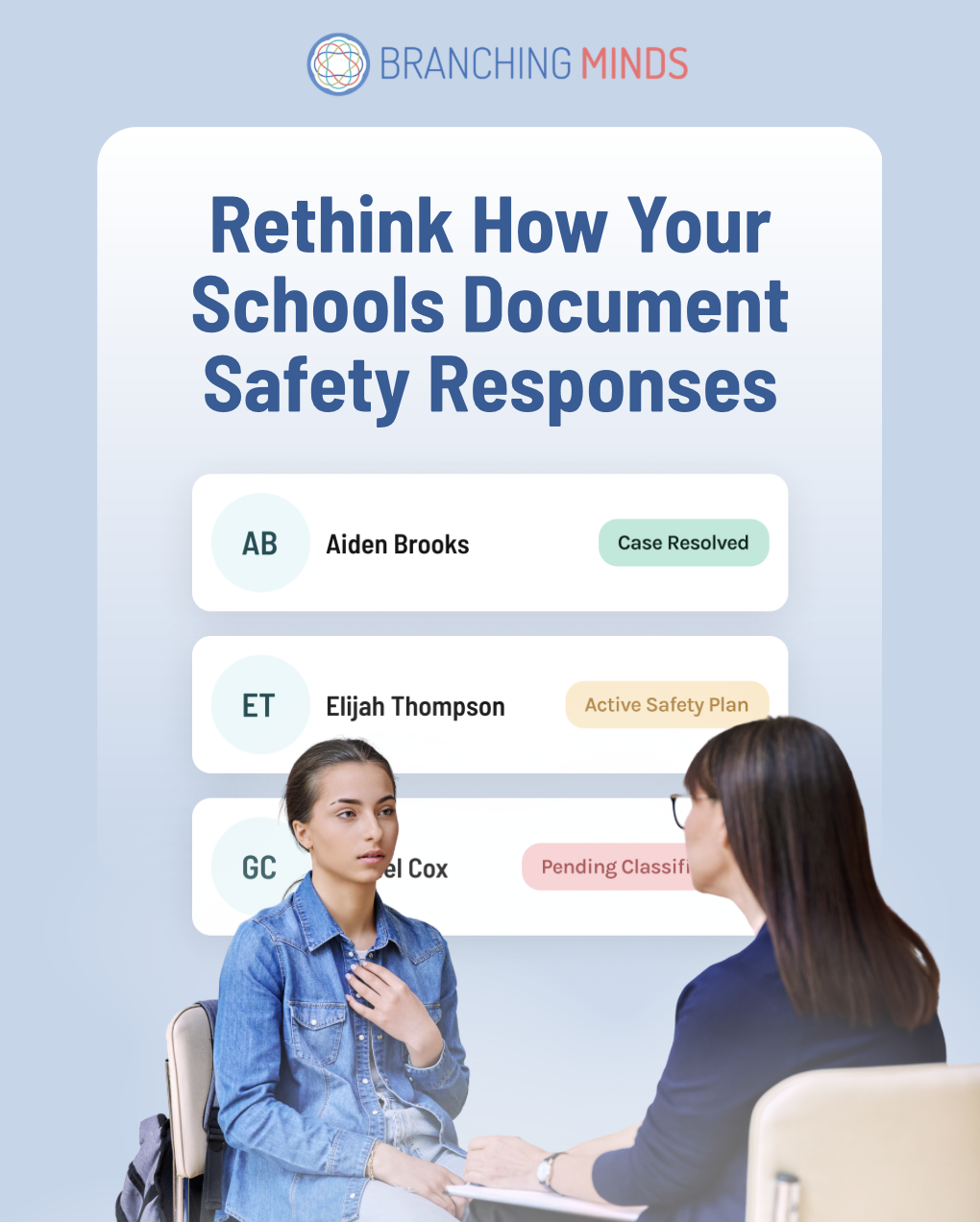
Safety Insights to Support Every Student
Bring threat assessment, suicide risk response, and student support planning together in one secure system.

.png?width=716&height=522&name=Restorative%20Practices%20(preview).png)
.png?width=716&height=522&name=HB%20605%20and%20School%20Safety%20NC%20(preview).png)
.png?width=716&height=522&name=3%20Things%20School%20Safety%20Teams%20Need%20to%20Be%20Effective%20(preview).png)