


































.png?width=444&height=266&name=Student-support%20(1).png)




.png?width=318&height=279&name=Evanston(tile).png)



.png?width=318&height=279&name=Teams%20Edweb%20(6).png)

.png?width=318&height=279&name=Best_Small_Workplaces-2026(no-text).png)




.png?width=1436&height=956&name=Restorative%20Practices%20(preview).png)
Most school safety systems are built to respond once a concern has already been raised. That work is important, but it leaves an open question: What has to be true on a campus for a concern to get raised before it becomes a crisis?
The answer? A restorative culture that builds trust before anything goes wrong, and a Multi-Tiered System of Support that provides structure for early identification of needs along with consistent intervention, collaboration, and follow-through.
Sherwynn Patton, Co-Executive Director of Life Anew Restorative Justice, and Brian Clason, Program Manager of Curriculum and Instruction at the Texas School Safety Center, joined Trudy Bender, experienced district administrator and Branching Minds MTSS Content Manager, to talk through the practical ways that Restorative Practices and MTSS enhance school safety.
.png?width=2250&height=1176&name=Enhancing%20School%20Safety%20Through%20Restorative%20Practices%20and%20MTSS%20(1).png)
1. Restorative Practices Are Set of Skills for Building Relationship and Solving Problems
Bender opened by describing restorative practices in three ways:
- A set of skills that help people build and maintain relationships
- A structure for meaningful conversation where every voice is valued
- A way of approaching problems that looks for root causes, not just consequences.
That third point matters for how a campus talks about discipline. Bender was direct about where consequences fit.
This reality points to something further upstream: real change happens when students have positive relationships, motivation, and hope that things can be different. A restorative culture is what creates the conditions for that, and it depends on everyone on campus, not just a counselor or a dedicated restorative practices facilitator.
Sherwynn Patton named the people who make up that culture:
- Parents and community supporters
- School counselors, teachers, and administrators
- Office, cafeteria, custodial, and transportation staff
- School-based law enforcement
Patton and Clason both pointed out that resource officers who understand restorative language help prevent escalation and become part of the healing process rather than an outside force reacting after the fact. The same logic extends to staff who are easy to overlook in behavior planning. Auxiliary and paraprofessional staff often have more day-to-day contact with students than anyone else, and they frequently know student families and neighborhoods best. They are a vital part of the team.
2. Trust Surfaces Problems Before They Escalate
Brian Clason described a pattern known as the Pathway to Violence. Students typically move through stages before an act of violence, not straight to it:
- Grievance: something has gone unresolved, socially, emotionally, or otherwise.
- Ideation: the student begins thinking about how to solve it.
- Planning and preparation: the student maps out and gathers what they'd need to act.
- Implementation: without intervention, the act itself.
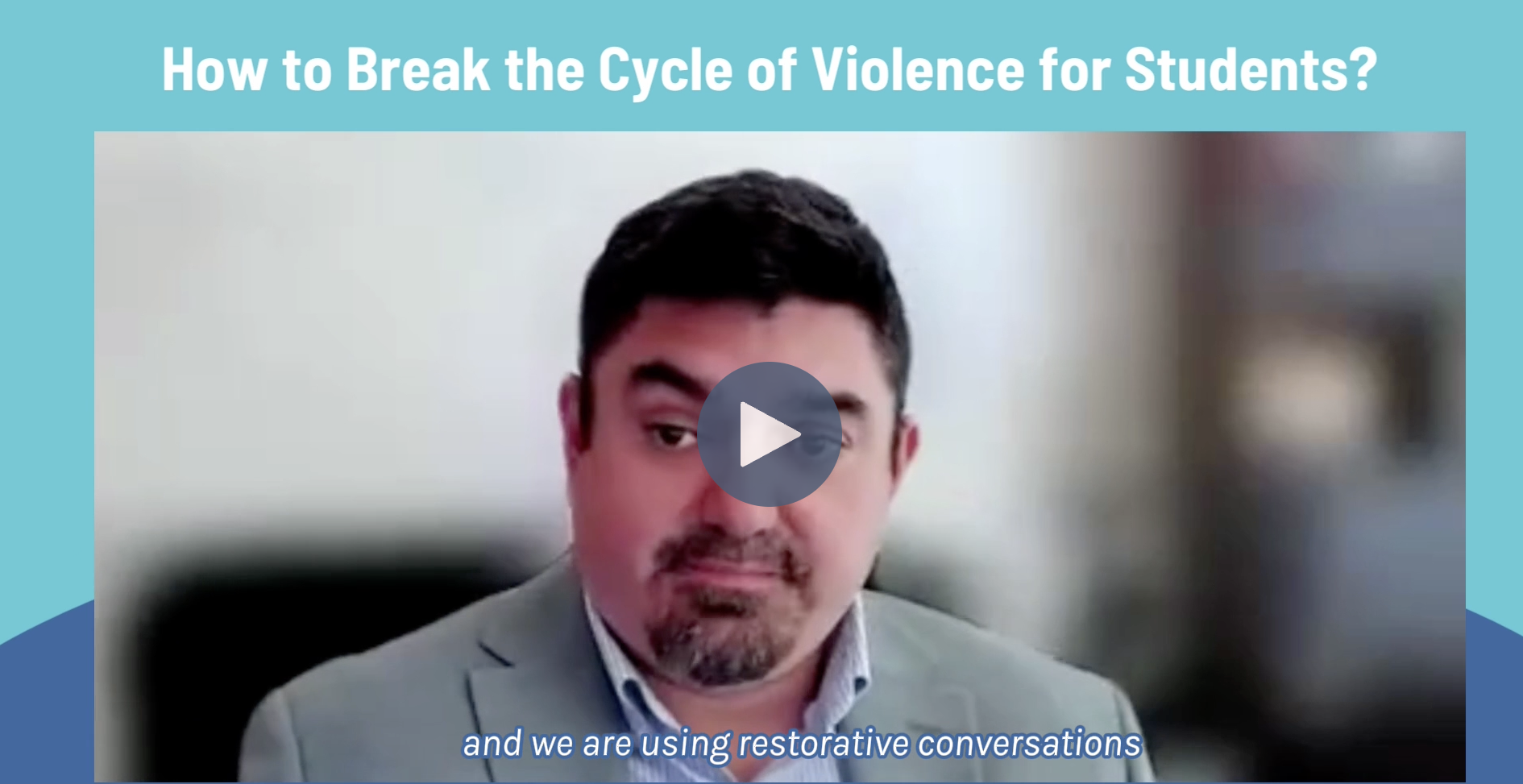
Along the way, students display what's called “leakage,” sharing pieces of what they're thinking in writing, out loud, or simply in how they show up differently.
Patton described a parallel approach through community violence intervention, built around trusted messengers, often people with life experience similar to the students they work with. Those relationships gave students someone to talk to before a situation became public or difficult to walk back. In one school, trusted messenger relationships led to five guns being removed from students in a single school year.
Bender added that the effect isn't limited to the student at the center of a concern. On a campus where relationships and restorative language are already in place, a student's peers become willing to come forward, too:
"It wasn't just that the student who might have been on this Pathway to Violence had connection. It was also all of the kids around that student who felt comfortable to go to someone on the campus and say, 'Hey, you need to know that this person is talking this way,' or, 'You need to know that this is going down at this time and in this place.' And those are conversations that would not have happened if we had not taken the time to build relationships with trusted adults on that campus."
3. MTSS Provides the Framework for Before and After
None of this holds up on individual relationships alone. A statewide project in Texas surveyed administrators who had successfully implemented restorative practices and asked what made the difference.
The most common factors:
- An established student support system already in place, with organized behavior intervention, SEL programming, and school-based mental health support already running.
- Staff who were open to innovation and change.
- Dedicated funding for a restorative practices coordinator
- External pressure from the community to address high discipline and disproportionality rates.
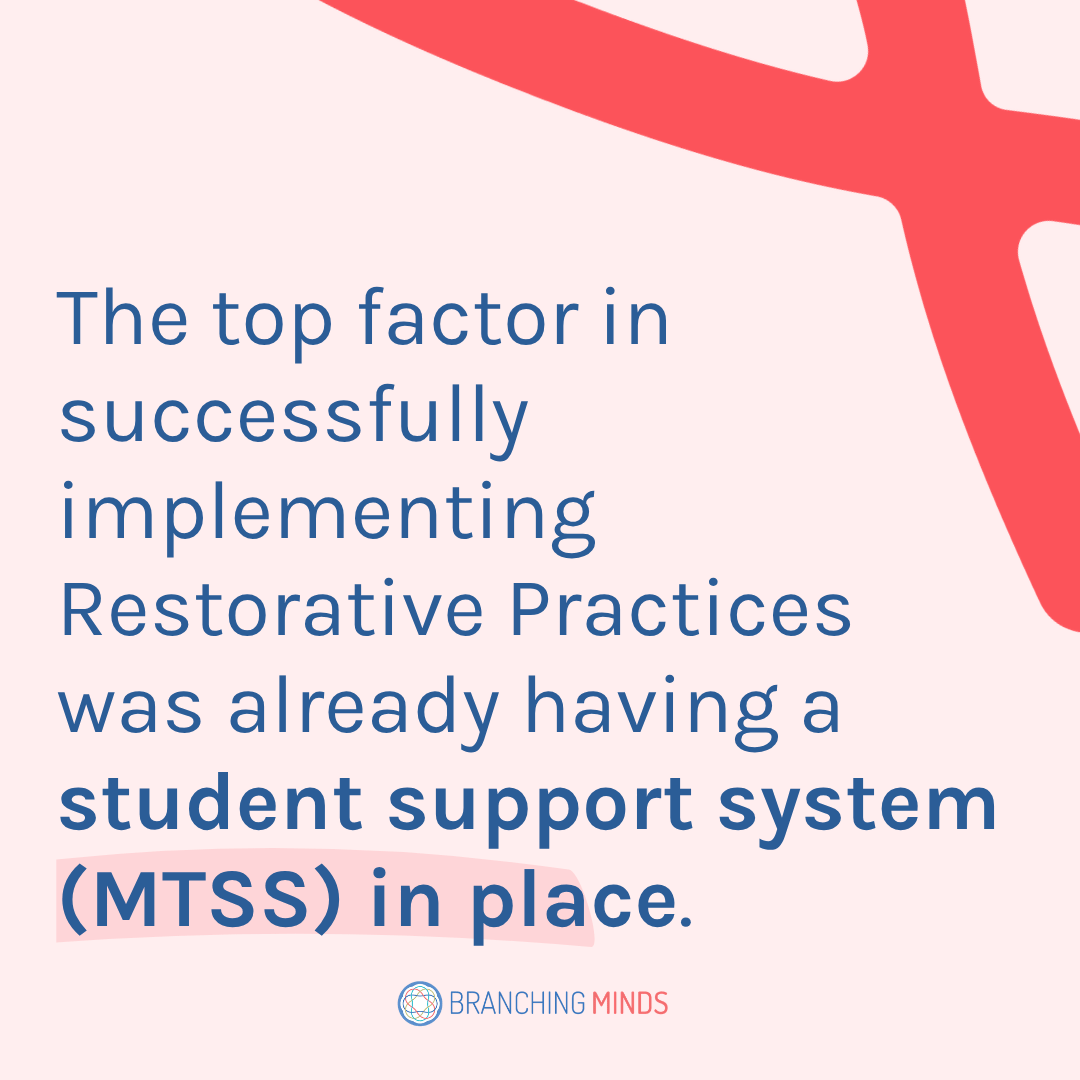
The top factor in successfully implementing Restorative Practices was already having a student support system (MTSS) in place.
In other words, the best way to implement Restorative Practices is to tie them to an existing MTSS framework instead of building something new alongside it.
The tiers line up directly:
- Tier 1: Community-building circles that include adults, not just students.
- Tier 2: Restorative conversations and harm-repair circles for small groups working through a specific issue.
- Tier 3: Circles of support and accountability along with re-entry circles for students returning from an alternative placement, with wrap-around services and an ongoing plan for intervention and follow-up.
That structure covers the after as much as the before. Bender described documenting and tracking every Tier 2 and Tier 3 restorative circle the same way as any other student support meeting and plan:
- A clear goal for the circle or conversation.
- A named person responsible for checking in on the plan over time.
- Regular family communication.
- Coordination with staff at any alternative placement the student is returning from.
Related Resource: Curious what makes a school safety team effective? Check out 3 Things School Safety Teams Need to Be Effective for practical guidance on building the right team structure.
How to Bring Restorative Practices Into Your MTSS Framework
Restorative practices aren't a replacement for consequences, and they aren't right for every situation, since they depend on consent from everyone involved. But a restorative culture is what makes a concern visible while there's still time to act on it, and an MTSS framework creates structures around the intervention and the support that has to follow.
Look at where your existing behavior intervention and mental health supports already live, and build Restorative Practices into that same structure rather than starting something separate. Start with the staff who are already curious, and let the culture build from there. The trust you build will enhance the safety of your students and staff.
Ready to strengthen your safety systems? Explore our Threat Assessment & Suicide Risk Screening Resource Center for guides, webinars, and real district stories on building proactive, MTSS-aligned safety practices.

Safety Insights to Support Every Student
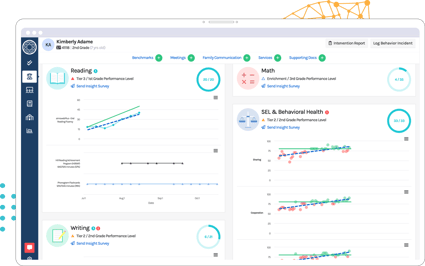
Bring threat assessment, suicide risk response, and student support planning together in one secure system.

.png?width=716&height=522&name=HB%20605%20and%20School%20Safety%20NC%20(preview).png)
.png?width=716&height=522&name=Behavior%20Progress%20Monitoring%20(Preview).png)