


































.png?width=444&height=266&name=Student-support%20(1).png)




.png?width=318&height=279&name=Evanston(tile).png)


.png?width=318&height=279&name=Teams%20Edweb%20(6).png)

.png?width=318&height=279&name=Best_Small_Workplaces-2026(no-text).png)



![[Guest Author] Morgan Goering-avatar](https://www.branchingminds.com/hs-fs/hubfs/image2.png?width=48&height=48&name=image2.png)

You watch your educators hustling at the end of the school day to create sub plans and make copies for tomorrow. You have asked your teachers to leave their classrooms in the hands of an unknown substitute to attend professional development for a new district initiative.
Fast forward a few years or even months, and you can’t remember what the initiative was, what the expectations were for you as an administrator or your educators, or even how to get ahold of the resources shared. Have you been there? This experience occurs far too often in education, as we continue to search for the silver bullet, the initiative to end all initiatives.
So much time, money, physical, and emotional investment can be saved by planning for sustainability with your professional development implementation.
Fortunately, MTSS itself holds the key — it’s a framework to support all learners. What if we applied that way of thinking to our adult learners?
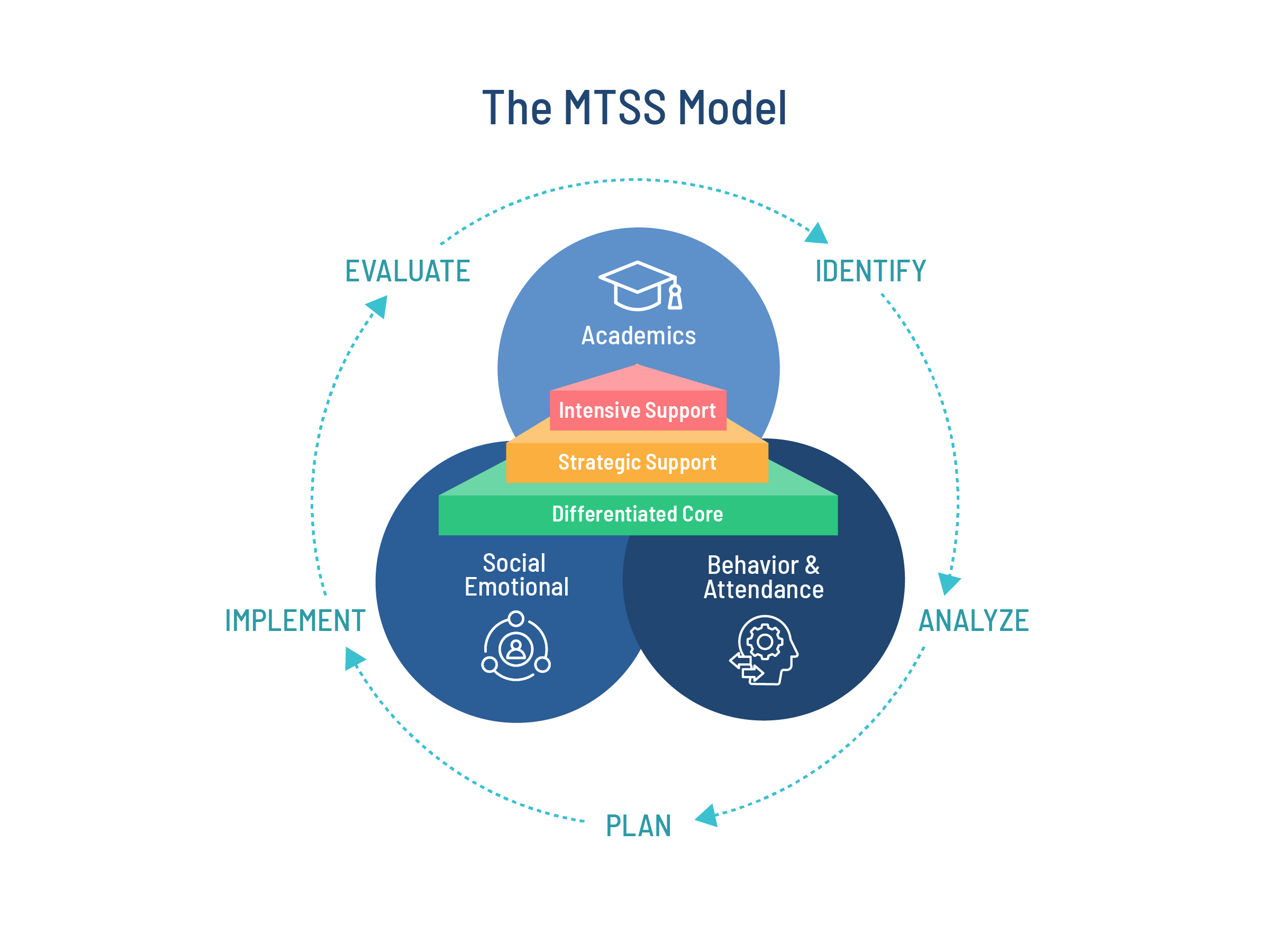
Just as a Multi-Tiered System of Supports (MTSS) provides universal, targeted, and intensive instruction for students depending on their needs, providing systematic MTSS learning for educators depending on their needs will have an exponential impact on your MTSS efforts over time.
To create an MTSS professional development plan that is sustainable and differentiated, district and site leaders will need to consider:
- Foundational principals
- Implementation protocols
- Sustainment practices
Foundational Principles
- Initiative planning: Professional development plans and initiatives are chosen at the district leadership level. Lead learners of MTSS are the first to start the conversation about MTSS in practice.
- MTSS as an operating system: Transitioning district operating systems to MTSS starts with clear communication about the definition of MTSS and what it will look like in the district.
Create Staff Buy-in
- Acknowledge the full plate of educators: Staff buy-in is built through understanding and reassurance that the expectations of a new initiative meet them where they are and are not just adding another item to their plate.
- Change management: Using a change management process to evaluate needs, establish clarity, and build consensus around the work allows for a foundation to be created for sustainable professional development implementation.
- Implement at a sustainable pace: Ensure leaders have the background knowledge, data, and clarity needed to start pushing the practice out to educators.
Related Resource: Mobilization Guide for MTSS
Assess Needs
Within the MTSS model, Tier 1 is often referred to as “differentiated core.” Meaning, the instruction that is provided is whole-class but is data-driven based on the needs of the whole population. To better understand the district’s population, a leader must first know the roles of the various staff on campuses, their time investments, current initiatives, and knowledge of MTSS practice.
Questions for Planning
- While teachers are often automatically considered for training in a new initiative, which teachers would be the most impactful to start the learning process with?
- What other staff roles will need training to support the practice being implemented on campuses?
- How can we ensure that the training provides what is needed without wasting time on items the educators already know?
Broaden the Scope
When planning professional development, leaders often single out the core educators who would be engaging in re-teaching opportunities for student success. A holistic approach acknowledges the diverse roles of staff beyond classroom teachers. All site-based educators will need to be informed about the practice and how their expertise can support the implementation of the model. Considerations include role type, interaction with students, and necessary tools for success.
Additional roles to consider include:
- Paraprofessionals
- Interventionists
- Specials/elective teachers
- Counselors
- Administrators
Implementation Protocols: Professional Development Formats, Scheduling, and Roll-out
Professional Development Formats
In post-pandemic education, we think more broadly about how professional development is best delivered. The availability of virtual training options allows educators to work with campuses without the additional stress of logistics planning for in-person training. However, for practices involving a mindset shift and significant collaboration, in-person training could still be the most effective. Once your district team has clarity around the work for buy-in purposes, evaluated the need for site-based training, and considered the types of staff that will participate in various levels of training, you are then ready to consider district-wide training for all educators.
Asynchronous Training
- Creates an accessibility that synchronous training cannot.
- Can be used to teach all educators about the theory, definitions, and protocols of MTSS practice: tiers of support, the importance of universal screening, data, progress monitoring, and the problem-solving process.
- Can be accessed at any time and allows site leaders flexibility in providing time for learning.
Related Resource: Professional learning, powered by Branching Minds.
Synchronous Training:
- Allows for deep interaction and instant responses to questions. This can create a quicker consensus and implementation of the practice.
- Once foundations of learning have been established, synchronous training can occur virtually or in person.
- Synchronous training would focus on the daily protocols for the implementation of the practice, including how students are screened, how educators identify students in need of support, the expectations for plan creation and progress monitoring, and protocols for increasing levels of support.
Scheduling and Roll-Out
Professional development time is always difficult to fit into the calendar as there are often competing initiatives and a desire to limit teachers’ time out of the classrooms. Grouping educators by their needs allows for shorter, more direct learning sessions. For example, after engaging in asynchronous work, counselors or social workers are ready to learn more about their expectations and tools for supporting students with their behavior, social-emotional, and mental health. A session dedicated to these types of educators can be tailored specifically to their expectations within MTSS practice. This will build buy-in as educators see that their time and expertise are respected by the professional development process.
Roll-out of MTSS training will often happen over a multi-year period, starting first with leaders and interventionists who are the early adopters of the work. These lead learners can ensure that the definitions fit the site’s reality and plan for the integration of MTSS within daily practice. Once the workflow is established, core content teachers, counselors, and paraprofessionals can be trained during the first year of implementation to establish a strong foundation of basic practices and prepare for the addition of more complex MTSS components.
Suggested groupings include, but are not limited to:
- Site administrators and PLC leads
- Interventionist and special education teachers
- Core content teachers (can be divided into subjects if the audience is larger, i.e. Math and Science or ELA and Social Studies)
- Counselors and Social Workers
- Paraprofessionals and Specials/Elective Teachers
Sustainment Practices: Continuous Differentiated Support
A long-term approach to professional learning is key to MTSS implementation. Staff turnover and promotion means that there are always educators new to the practice of MTSS or to their role in this framework.
As with MTSS for students, consider:
- What does every staff member need to know about MTSS?
- How will we ensure that new staff members are scaffolded into MTSS practice?
- What differentiation is needed for different roles?
- Which campuses or staff members need additional help?
When implementation of MTSS is expected district or site-wide, providing a platform for accountability can be the next logical step in continuing to support the practice. The Branching Minds platform creates a place where educators can document their efforts to support student growth. Having a place where these efforts are tracked and documented allows district leaders to determine what is needed to further support sites and educators.

This insight helps leaders be targeted in how they support educators with MTSS:
- Are more or different interventions needed to better provide effective intervention practice?
- Is progress monitoring taking place?
- Are interventions being carried out? With fidelity?
- What are the needs for specific schools, grade levels, and roles
Key Actions for Sustainable MTSS PD
To create a sustainable professional development plan, district and site leaders can apply the principles of MTSS to the way they support teachers:
- Determine what training is needed by everyone to set a foundation of support.
- Differentiate professional development based on role and years of service.
- Develop a plan for teaching new staff about MTSS implementation.
- Use data to determine which staff need additional coaching, resources, or other support.
![[Guest Author] Morgan Goering-avatar](https://www.branchingminds.com/hs-fs/hubfs/image2.png?width=82&height=82&name=image2.png)

MTSS Professional Learning
Strengthen educator practice and build more consistent MTSS implementation across your district with onsite and virtual professional learning.

-1.png?width=716&height=522&name=Washingtons%20RTI%20Requirement%20for%20SLD%20Eligibility(preview)-1.png)
.png?width=716&height=522&name=How%20Illinois%20Districts%20Can%20Fund%20RTI%20MTSS%20Infrastructure%20(preview).png)
.png?width=716&height=522&name=Californias%20Budget%20Is%20Betting%20Big%20on%20MTSS%20and%20Community%20Schools%20%20(Preview).png)